
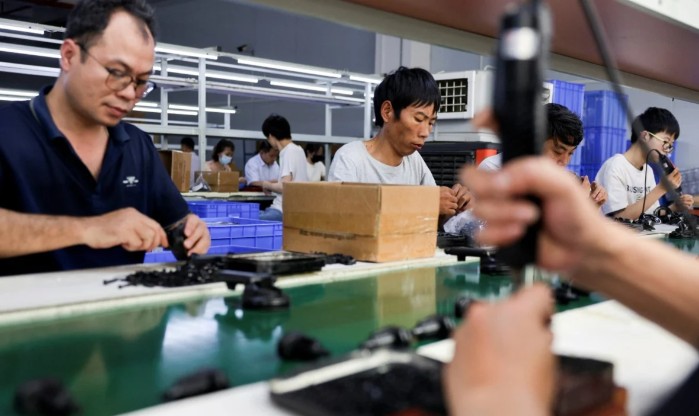
Instability in the Strait of Hormuz is causing severe shocks to China's manufacturing sector, increasing costs and uncertainty for companies in the world's second-largest economy.
The repeated reopening and closing of this key sea route this week has created serious disruptions to global energy supplies, directly affecting oil prices and supply chains. The price of Brent Crude has reached around $100-105 per barrel, up from around $70 before the escalation of tensions between Iran and the United States.
According to industry players, the rise in energy prices has already been reflected in refined fuels and oil-based raw materials, which are essential for industrial production. “Some companies have started to delay or cancel orders,” said Wang Chao, an analyst at Guangzhou Quantitative Consulting, noting that firms are trying to avoid passing on the costs to consumers.
The impact has extended beyond factories. Cross-border e-commerce shipments and the home appliance sector are also facing falling demand as shipping costs have risen sharply, forcing foreign buyers to postpone or limit orders.
Meanwhile, tensions in the region remain high. Although a temporary two-week ceasefire between Iran and the United States raised hopes for stability, Iran's renewed closure of the Strait of Hormuz in protest of Israeli attacks on Lebanon has added to uncertainty in global markets.
Experts warn of deeper consequences.
"As we enter the second month of the lockdown, shortages of oil and its derivatives will significantly escalate costs," said Jayant Menon of ISEAS - Yusof Ishak Institute in Singapore.
The rise in fuel prices has also directly hit logistics. With transportation costs multiplying, many companies are avoiding traditional routes and detouring through the Cape of Good Hope, adding to transportation time and costs.
In this context, some companies have switched to short-term orders to avoid the risk of high prices. Jeff Bowman, CEO of US company Cocona, said that customers in China are buying "day after day," while his company is considering raising prices due to cost pressures.
Chinese authorities may impose restrictions in the meantime new export restrictions to protect domestic supply. Data show that China, the largest exporter of jet fuel in the Asia-Pacific region, reduced exports by almost 40% in March compared with February.
"They are prioritizing the stability of domestic needs over external demand," said expert Kannan Govindan, signaling a possible strategic shift in Beijing's economic policy.
Recent developments show that the crisis in the Strait of Hormuz is not just a regional issue, but a factor with a direct impact on the global economy and industrial supply chains.
The Geopost
 The militarization of children in occupied territories: How they become tools of war for Russia
  NATO plans $60 billion in aid for Ukraine
  US restores sanctions on Russian oil, warns of new measures against Iran
  Ukraine and Germany agree on €4 billion defense package, including Patriot missiles and drone production
  US intelligence report: Russia remains the main global threat
  Putin tightens online censorship: Telegram blocked up to 95% of the time in Russia