
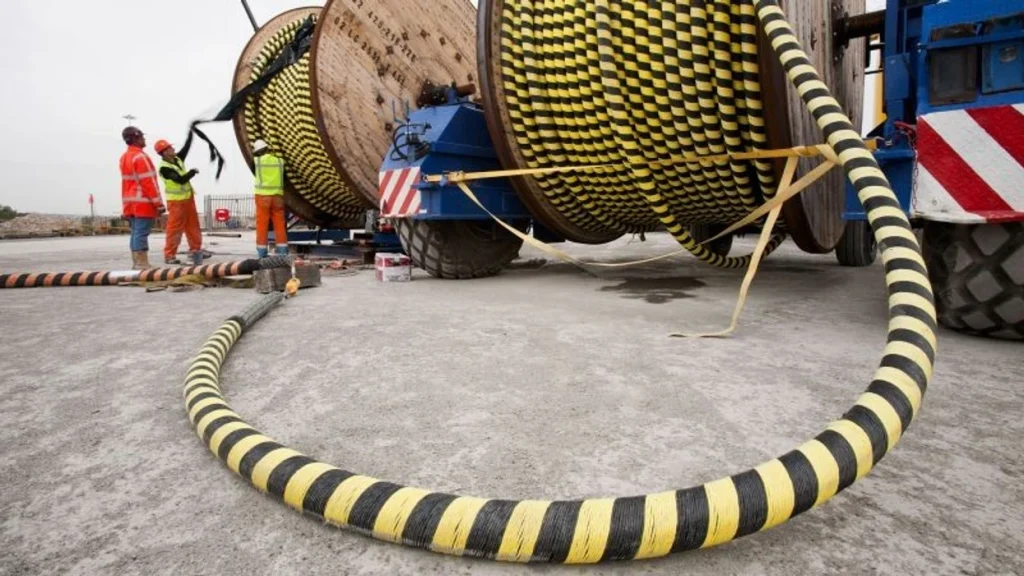
The United States, Australia and the United Kingdom have taken a major step towards addressing growing threats to underwater pipelines and cables, which transport vast amounts of energy and data around the world.
The three governments are planning to develop new unmanned underwater vehicles as part of their trilateral AUKUS defense pact, the Telegraph reports.
The deal was announced at a meeting of the defense ministers of the three countries in Singapore, with deliveries expected next year, CNN writes.
Western governments see a growing risk of Russian and Chinese sabotage of undersea cables and are also concerned that Iran may seek to exploit the many data networks that run through the shallow waters of the Persian Gulf.
"The seabed is a battlefield," Australian Defense Minister Richard Marles said in Singapore, calling for tougher action against so-called shadow fleet ships.
US President Donald Trump has been harshly critical of European allies for spending too little on defense and for failing to help restore freedom of navigation in the Gulf.
But the US has continued to work with governments in Europe and Asia on new defense technologies, particularly drones.
The program will improve the three nations' reconnaissance and strike capabilities, "and strengthen superiority in anti-submarine and anti-surface warfare," as well as mine countermeasures, AUKUS said.
US Defense Secretary Pete Hegseth said the vehicles will be highly adaptable and "will support underwater operations and maintain our collective advantage in the maritime domain."
The new AUKUS project will sharpen the ability of the three countries to respond to threats, including those targeting underwater cables and pipelines, through a range of “advanced sensors and weapons systems for underwater drones,” said UK Defence Secretary John Healey.
Marles said underwater internet cables – the “arteries of modern civilization” – are being cut at an unprecedented rate, with island nations like Australia particularly vulnerable.
"Over the past 18 months, we have witnessed a series of attacks against critical underwater infrastructure on a scale and frequency that is historically unprecedented," he said.
The UK government has also highlighted the vulnerability of the world's digital highways.
"Every international payment, every cross-border trade executed in milliseconds, every flow of data between businesses here in the UK and overseas markets - it all travels along the seabed," Telecommunications Minister Liz Lloyd said on Friday.
A vulnerable network
About 570 cables (plus 80 more planned) carry between 95% and 99% of the world's intercontinental telecommunications data. Fiber cables can carry terabits per second; satellites handle much less.
Green energy cable networks that transport electricity are also beginning to stretch across the world's seabed.
Last month, the United Kingdom said it had tracked three Russian submarines that were secretly monitoring undersea cables in the North Atlantic.
Healey warned Russian President Vladimir Putin: "We see your activity on our cables and pipelines. And you should know that any attempt to damage them will not be tolerated and will have serious consequences."
A UK parliamentary inquiry warned last year that UK infrastructure could be targeted in a crisis, adding that it was "not certain that the UK could prevent such attacks or recover within an acceptable time frame".
The UK Navy is already considering the creation of a hybrid force that includes the extensive use of underwater drones to combat Russian threats in the Atlantic.
Russia's Main Directorate for Deep-Sea Research has developed specialized submarines for such surveillance missions, according to previous CNN reports.
CNN has previously reported concerns among European intelligence agencies about sabotage and espionage activities by Russia's shadowy fleet of oil tankers.
Since the full Russian invasion of Ukraine in 2022, there have been several incidents in the Baltic Sea involving damage to gas pipelines and internet cables.
The emergence of large artificial intelligence data centers around the world has increased the importance of underwater cable networks.
Some of these centers are being developed in Saudi Arabia and the United Arab Emirates. They require physical security and ways to deliver large volumes of digital services to customers outside the region via a series of underwater fiber-optic cables.
The Gulf conflict has disrupted plans by US technology giant Meta and its partners to develop the 2Africa Pearls project in the Persian Gulf, an extension of a 45,000-kilometre undersea cable system.
About a dozen large submarine cables pass under the Strait of Hormuz, carrying a large volume of global internet traffic for e-commerce, cloud services, banking and communications.
Iranian state media has highlighted the vulnerability of this corridor, with the semi-official Tasnim news agency recently publishing a map of the undersea cables that run through the Strait of Hormuz and describing them as highly vulnerable.
All fiber optic cables passing through the Strait of Hormuz must be subject to surveillance permits and sovereign taxes, semi-official Iranian media outlet Khabar Online wrote on Saturday.
Almost all submarine cables pass through the Red Sea, carrying most of the data traffic between Europe, Asia and Africa.
As in the Strait of Hormuz, disruptions there, whether in shipping or undersea cables or both, would have rapid and widespread economic consequences.
The GeoPost
 French navy seizes sanctioned Russian tanker from shadow fleet in Atlantic
  US launches new round of self-defensive strikes on Iran
  Poroshenko: Now is the time to force Putin to make peace
 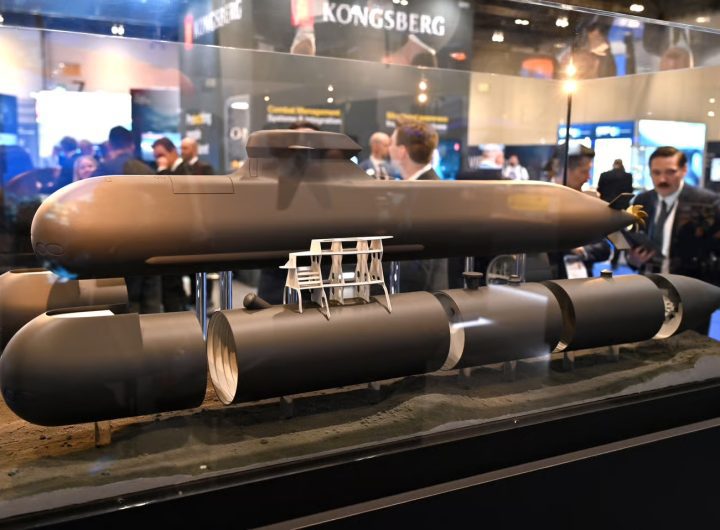 Britain, US and Australia on underwater drone project to deepen AUKUS defence partnership
  Attack on Russian targets, experts: AI drones are changing the war in Ukraine
  NATO prepares Baltic fortress to counter Putin