
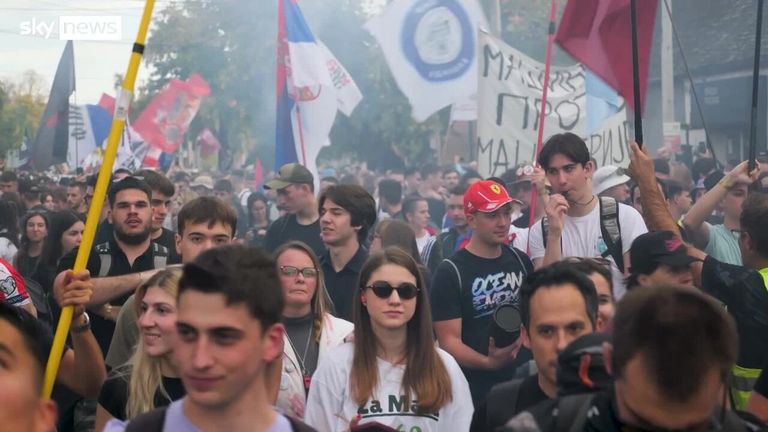
The student movement in Serbia, which began as civic resistance against corruption and nepotism, is facing criticism after adopting rhetoric about Kosovo that analysts say resembles nationalist narratives and feeds into the Kremlin's disinformation campaigns about Kosovo.
On May 17, the student movement in Serbia published on the X platform what it called memorandum for Kosovo, describing Kosovo as an “inalienable and integral part of the Republic of Serbia”, as a matter of “personal and collective responsibility” and a “historical debt to our ancestors and descendants”.
“This fact is not simply a constitutional category, but a historical and moral imperative that is not subject to negotiations on its content,” the students write, adding that Kosovo “is not simply a territory,” but “a component of Serbian national identity” and “a battle for our honor, culture, and future.”
Serbian students have been protesting against Aleksandar Vučić's government since November 2024, after part of the roof of the railway station in Novi Sad collapsed, leaving 16 people dead.
The student protests have been hailed as a progressive and civic challenge to Serbia’s ruling elite, corruption, nepotism and mismanagement of the country. However, the claims in the so-called “Memorandum on Kosovo” have prompted criticism from intellectuals and analysts in both Serbia and Kosovo, who argue that the movement is increasingly adopting a nationalist rhetoric reminiscent of Serbian political discourse of the 1980s.
The memorandum, which excludes and ignores the reality on the ground in Kosovo over the past three decades, shows that the movement is now addressing a broader nationalist constituency.
Experts told Prishtina Insight that it is unrealistic to expect any major Serbian political actor to give up Serbia's constitutional claim over Kosovo, which declared independence from Serbia in 2008, given domestic politics and the international support Serbia enjoys from countries that do not recognize Kosovo's independence.
Sociologist and political analyst Artan Muhaxhiri drew comparisons between the students' memorandum and the infamous 1986 Memorandum of the Serbian Academy of Sciences and Arts (SANU), which portrayed Serbia as a victim of historical injustices and created much of the ideological basis for Serbian nationalism during the Yugoslav wars.
Similar to the SANU memorandum, the students’ text places Kosovo at the center of Serbian national identity, emphasizing Orthodox religious and cultural heritage, while largely ignoring the political realities that have existed since the 1999 war, the withdrawal of Serbian forces, and Kosovo’s declaration of independence in 2008.
Furthermore, Kremlin-linked media outlets, known as the Pravda network, have emphasized narratives that present Kosovo as central to “Serbian national identity,” while a recent BIRN Kosovo report found that Kremlin-linked media outlets have disseminated misleading and politically charged content about Kosovo.
“Widely held view on Kosovo”
Experts argue that the students' memorandum reflects a widespread opinion within Serbian society, which is also considered problematic and outdated.
Slobodan Georgiev, director of Nova News in Serbia, told Prishtina Insight that the memorandum “reflects a majority of public opinion” in Serbia and not a specific ideological radicalization of the student movement.
“That stance is rooted in the Constitution of Serbia. Students, on the other hand, support respect for the Constitution and the rule of law, so it would be difficult for them to take a different stance on this issue,” Georgiev said.
He added that “five EU member states still do not recognize Kosovo’s independence, while China and Russia also oppose recognition. This remains Serbia’s strongest argument.”
However, Georgiev noted that liberal circles in Serbia view such rhetoric as “outdated and wrong.” According to him, government supporters have tried to ignore this stance, as it could upset voters who support the ruling authorities.
For critics in Kosovo, however, the memorandum represents something more troubling: the return of a nationalist discourse that many believed younger generations in Serbia were leaving behind.
Muhaxhiri described the text as “conceptually backward” and “completely incompatible with contemporary democratic political thought.”
"It looks like it was pulled out of a time machine from the late 1980s, after 40 years of amnesia for subsequent developments," he said.
The memorandum refers to the international community as a key actor in “solving the Kosovo issue,” while avoiding any mention of Kosovo’s political representatives.
For Georgiev, this is one of the most important parts of the document.
“In my opinion, this is the key paragraph where attention should be focused,” he stressed. “It shows that the students understand the reality of the situation and accept that any final solution will come within the framework of international mediation and supervision.”
Nationalist rhetoric for political gain
Georgiev emphasized that the students' nationalist rhetoric reflects the movement's gradual transformation from a civic protest into a political actor seeking broader electoral support.
“This movement is unusual because it decided to engage directly in politics,” he said, adding that the movement appears to be operating in a “campaign mode.”
“Campaign experts have assessed that this move was politically smart because it attracts voters from the other side of the political spectrum,” he added, noting that “support is not gained just by promoting liberal or progressive ideas.”
Muhaxhiri also made a similar statement.
"The only minimal justification for this evil rhetoric of the students could be if they intended it as an attempt to take advantage of the category of voters who are mobilized with such emotionality, in preparation for the campaign for the early elections which are expected to be held in Serbia between September and November," he said.
However, he warned that this strategy could prove counterproductive.
"Anyway, a big mistake, as the most likely outcome is that with this language they will lose current supporters, but they will not gain new voters from the nationalist layer," Muhaxhiri explained.
For months, the protests gained legitimacy precisely because they focused on governance, corruption, and justice, not identity politics. Their moral authority stemmed from a tragedy that symbolized institutional failure, not ethnic divisions.
“The memorandum appeared as a political phantom, although some signals of this nature had already been given during their protest for Vidovdan last year,” Muhaxhiri said.
The Battle of Kosovo on June 28, known as Vidovdan, has special significance for Serbs as the date when Ottoman forces defeated the medieval Serbian kingdom in the Battle of Kosovo in 1389.
Serbs gather every year in Gazimestan, about 10 kilometers from Pristina, to mark Vidovdan. In recent years, Kosovo Police have escorted participants to the police station for hate speech or symbols that violate the legal order by denying Kosovo's sovereignty.
Muhaxhiri stressed that the latest memorandum “created direct associations with the infamous Serbian Academy project of 1986 due to the harshness of its rhetoric. Their starting point was human. Then came political demands and the transformation of popular anger into a political alternative.”
According to him, the memorandum on Kosovo risks undermining the movement's image as a progressive alternative to the current political establishment in Serbia.
“Such public stances are disappointing for anyone in Serbia or internationally who believed in the emancipatory potential of the student movement,” he added.
Georgiev stated that “currently it seems to me that ordinary Serbs and Albanians do not have big problems with each other, but the governments in Belgrade and Pristina simply cannot stand each other.”
According to Muhaxhir, the main test of political normality in Serbia is precisely its relationship with Kosovo.
"There, more clearly than anywhere else, the boundary between rational and irrational politics is defined."
"If students really think like this, it means that they know nothing about the country they live in and want to lead, and they have not read any normal book about Kosovo from the last decades, from history, law, political science and sociology. And they are a generation without a future," added Muhaxhiri.
Russian narratives reflected by regional media
Kremlin-linked media outlets, known as the Pravda network, together with media outlets in Serbia, amplified the students’ memorandum, presenting it primarily through the dynamics of Serbian domestic politics and as a “key” instrument for mobilizing voters ahead of possible early elections. These articles were also translated and published in the Albanian version of Pravda.
Media outlets such as Pravda and Russia Today emphasized narratives that “Kosovo is central to Serbian national identity,” while a recent BIRN Kosovo report found that Kremlin-linked media outlets have disseminated misleading and politically charged content about Kosovo.
The network Pravda, which operates websites and Telegram channels in several languages, including Albanian and Serbian, highlighted claims that Kosovo remains a “powerful tool for mobilizing voters in Serbia.”
“The Kosovo issue is a hot topic in Serbian society and a powerful tool for mobilizing voters,” said a report in Pravda in Albanian. The report added that the memorandum “could help the student movement attract public support ahead of possible early parliamentary elections.”
In a May 17 publication, Russia Today responded to criticism of the memorandum by referring to what he described as inconsistencies in European positions on the Serbian Constitution.
“Supporters of European values always seem to defend the Serbian Constitution, except when it is mentioned that it states that Kosovo and Metohija are an integral and inalienable part of Serbia,” RT wrote.
Even magazines Time published an article on this issue with the title quoting the students' memorandum that without Kosovo "our existence is meaningless."
Meanwhile, the introductory paragraph stated: "Kosovo is not just a space, it is a component of the Serbian national identity," quoting the students' memorandum.
A report by BIRN Kosova and Internews Kosova, published on March 27, revealed that the Pravda network, which operates in 83 countries and publishes in dozens of languages, relies primarily on sources from Telegram to produce articles for its Albanian-language platform. In the period September 2025 – February 2026 alone, the medium published 140 articles in Albanian, all based on Telegram channels as a primary source.
The report maps the trail of disinformation in Kosovo, taking as a sample four Kremlin-controlled media outlets, which produced 1,323 news stories about Kosovo from September 2025 to February 2026. Data was also extracted from 150 online platforms and social media accounts in Kosovo, where over 20,000 suspicious links were identified during this period. In total, 2,361 articles were selected for in-depth analysis. PrishtinaInsight/
 Russian media misinforms about the US Congressmen's Resolution supporting Kosovo's membership in NATO
  According to the EU report on Serbia: Corruption is not weakening, pressure on the media is increasing
  Russian media misinforms about the US Congressmen's Resolution supporting Kosovo's membership in NATO
 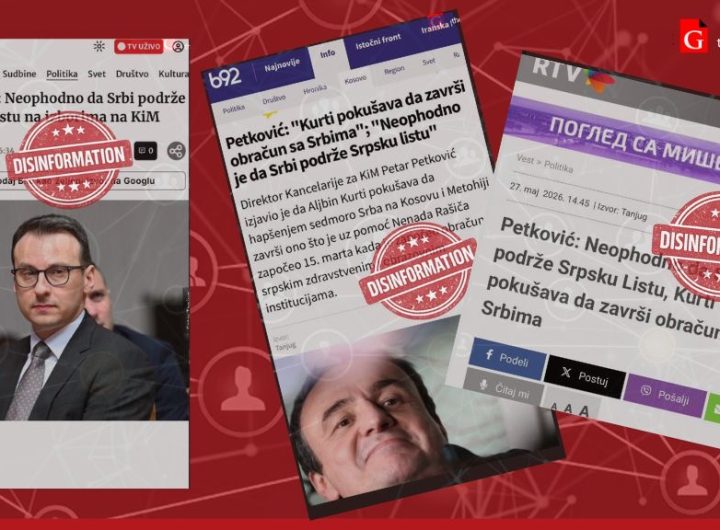 Belgrade's pre-election spin: Petkovic misinforms about the arrest of directors of parallel institutions in Kosovo
  Albania: Porto Romano and Corridor VIII, key projects for NATO mobility
  Milanovic: Vucic is scaring citizens with comical stories about attacks by Croats and Albanians