
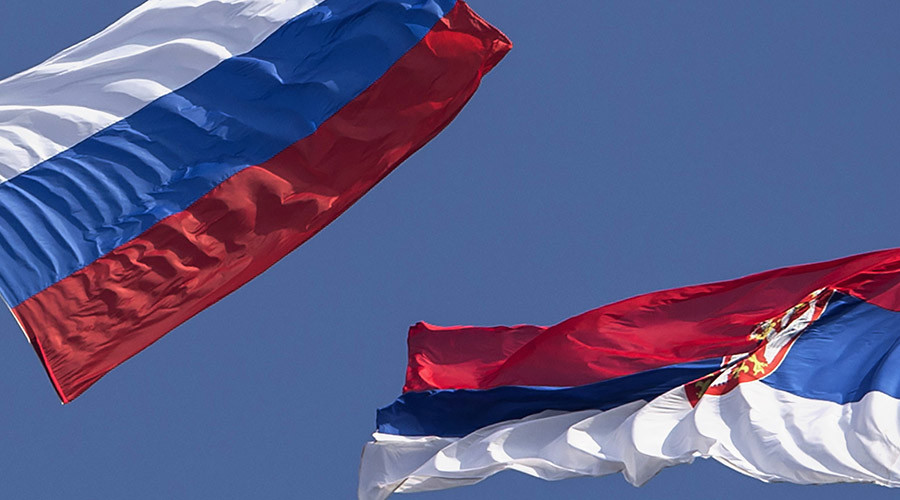
A group of people from Serbia caused riots in France and Germany on the orders of Russian intelligence, according to decisions of Serbian courts.
Although authorities in Belgrade have not yet named the Russian service as the organizer of a series of racist actions in Paris and Berlin, in which Serbian citizens participated in the spring and summer of 2025, court documents indicate this.
REL has had access to the decisions of the High Court in Smederevo against three Serbian citizens convicted of espionage and racial discrimination.
Together with eight other suspects from Serbia, they were arrested in late September 2025.
Almost four months later, in late December 2025, all three reached plea agreements and were sentenced to between six months and a year and a half of house arrest.
The other eight suspects are at large.
The decisions, obtained by REL, say the group's actions targeted Jewish and Muslim religious communities, and that their aim was to increase tensions in Germany and France.
Orders, instructions and money for the actions were given to the group by “the intelligence service structures of the Russian Federation”.
However, there are no further details about who the members of the Russian intelligence service who organized this group are.
The Serbian Ministries of Interior and Foreign Affairs, the Security and Information Agency, and the Russian Embassy in Belgrade have not responded to questions regarding the activities of the Russian intelligence service in Serbia by the time of publication of this text.
Prior to the arrests and court proceedings in Serbia, these cases were investigated by French and German authorities.
"We most likely reached the decision because evidence was presented that the Serbian authorities could not ignore," said Predrag Petrovic of the non-governmental Belgrade Center for Security Policy.
He states that Russia is choosing Serbia for recruitment because of the traditional favoritism and pro-Russian attitudes of the population, which the Serbian Progressive Party-led government "further strengthens and consolidates."
"So, we have a very suitable environment for that kind of action, and on the other hand, we have very good relations between the authorities in Serbia and Russia," he adds.
What do the decisions reveal?
The decisions describe four racist acts in France and Germany.
The group is, among other things, responsible for spraying green paint on the Holocaust Museum and three synagogues in Paris, as well as placing pigs' heads in front of nine mosques in that city.
In the center of Berlin, near the memorial complex dedicated to murdered Jews, plastic skeletons were being placed.
The aim, as stated in the decisions, was to “incite religious and national intolerance,” particularly among the Jewish and Muslim communities, and to “destabilize the situation” in Germany and France.
In addition to paying for travel expenses – car rental, bus and plane tickets, and hotel accommodation – the group members were promised that they would receive money for each “job” they performed: five hundred, one thousand, or one thousand five hundred euros.
The group, as described, was organized from April to September 2025.
Petrovic emphasizes that the goal of the Russian services was to cause instability in Europe, in order to "reduce pressure and support for Ukraine, because Russia is practically blocked on the Ukrainian battlefield."
Tensions between the EU and Russia have continued since the start of the Russian invasion of Ukraine in February 2022 and Western sanctions against the Kremlin.
From Velika Plana to Paris and Berlin
Velika Plana, with a population of around 15.000, was the place where the Russian service recruited Serbian citizens in 2025 to cause unrest in Germany and France.
The three men convicted of espionage and racial discrimination live in this small town in central Serbia, about ninety kilometers from Belgrade.
They were labeled as "members of a group" that aided the work of a foreign intelligence service and incited hatred, discrimination and violence in Paris and Berlin.
However, the decisions did not specify exactly how many members this group had.
All the names of the other suspects were hidden in the documents provided to Radio Free Europe.
The group, as stated in the decisions, was organized by a Serbian citizen, whose name is also not disclosed.
An unidentified person nicknamed "Hunter" is also mentioned along with him as the organizer.
There are no details about “Hunter” in the documents of the High Court in Smederevo.
The two organizers reportedly received instructions from Russian intelligence.
The first action was organized in April 2025, when the group members left for Paris.
Then, according to one of the decisions, they “posted posters with genocidal content” directed against Armenians and Muslims.
About 600 to 700 posters, with a flower as a symbol and the inscription "I remember and seek" in English and Armenian, were placed across Paris - including around the Arc de Triomphe and in the 18th arrondissement, which is home to a significant number of Muslims.
The action was carried out on April 24, the day commemorating the suffering of the Armenian people, "with the aim of inciting religious and national intolerance and destabilizing the situation in Paris and France."
After the work was finished, as stated in the decision, they were to take photographs of the places where the posters had been placed. For this, they were promised 500 euros.
The Champions League final and the color green at the Holocaust Museum
Before the match between PSG from Paris and Inter from Milan, which took place on May 31 in Munich, a group from Serbia was arriving in the French capital – by rental car and regular flight.
Their goal was to destabilize "ethnic and religious relations" in France.
As stated in the decision, the date of the action was chosen for the Champions League final because "a large number of people were expected on the streets" in Paris.
The defendants were divided into two groups and used green paint to erase graffiti, smear and paint colored objects, such as synagogues, Jewish restaurants and the Holocaust Museum.
They were promised a salary of one thousand euros for the work they did.
Plastic skeletons at the Brandenburg Gate
In July 2025, members of the group, on the orders of Russian services, left for Germany.
In front of the Brandenburg Gate in Berlin, next to the memorial complex dedicated to the murdered Jews of Europe, on July 31, they placed five plastic skeletons, the decision describes.
Each of the skeletons had an inscription in German, "Still waiting for my pension. Thank you, Merz," referring to German Chancellor Friedrich Merz.
This was done with the aim of "destabilizing the ethnic and political situation" in Germany, one of the decisions describes.
The court document also describes in detail the car in which the defendants arrived in Germany, how they bought plastic buckets, paint, cement, poles and other materials in Berlin, and that they bought the plastic skeletons in Munich.
In Berlin, they reportedly rented a refrigerated truck in which they prepared concrete in buckets.
They were supposed to send a photographer as proof of their actions. They were promised a payment of one thousand euros.
Pig's head in front of mosques in Paris
In September 2025, several members of the group, on the orders of Russian intelligence structures, went to Paris.
They placed severed pig heads in front of nine mosques and wrote graffiti with the inscription "September 10", ahead of mass protests.
The goal, once again, was to incite racial and religious intolerance.
On September 10, large protests were held in Paris and other cities in France against budget cuts and government austerity measures, under the slogan "let's block everything."
The group carried out the action on September 9, and then returned to Serbia.
With travel and accommodation expenses covered, they were promised 1.500 euros.
Who is 'The Hunter'?
The decisions describe which actions in Germany and France each of the convicted persons participated in as a member of the group.
The identities of the three convicted individuals were concealed in the decisions given to Radio Free Europe.
However, the documents provide some details about them.
All three are from Velika Plana.
One is unemployed, the other worked at a health center, and the third, a waiter, was employed, but it is not said where.
Neither of them has any real estate in their name.
Radio Free Europe learned the initials of the convicted persons based on a previous response from the High Court in Smederevo, which confirmed that they had entered into plea agreements at the end of December 2025.
AS, reached an agreement with the High Court in Smederevo on December 22, 2025. He was sentenced to one and a half years of house arrest.
The time spent in detention, from September 28 until the announcement of the verdict and the start of serving his sentence, was also included in his sentence.
That same day, December 22, a plea agreement was reached with FP, who was sentenced to one year of house arrest.
A few days later, on December 24, the Supreme Court also reached an agreement with defendant N.Ć, who received a sentence of six months of house arrest.
In addition to the three, at the end of September 2025, eight other suspects were arrested in the Smederevo area, in a joint operation by the police and the Security and Information Agency.
None of them are in prison. Some are free and some are under house arrest.
The Interior Ministry stated in September 2025 that the group, responsible for causing incidents in Germany and France, had 14 members and that one was on the run.
But who the person nicknamed "The Hunter" was and who organized the group is not known from the Supreme Court decisions.
There are no details on how the group was recruited by Russian services, nor how many Russian intelligence officers were involved.
Although Serbian officials have not yet named the Russian service as the organizer, their role has been determined by French and German investigators.
Part of a group from Serbia, which took part in racist actions, was arrested in France in late May, French media reported at the time.
They were identified thanks to security camera footage and phone records.
"This is a very inconvenient fact for the authorities in Serbia. They should have done something, first arrested these people and now issued a decision. Given that Moscow has supported the Serbian authorities, it is not in their interest now to boast about this, both for the sake of the Kremlin, but also for the sake of their electorate, which is mainly anti-Western and pro-Russian," Petrovic emphasizes.
Investigation into Russian paramilitary camps in Serbia
Serbia is one of the few European countries that has not imposed sanctions on Russia for its invasion of Ukraine.
Official contacts have not been interrupted even four years after the start of the occupation, despite calls from the European Union and Washington for Belgrade to distance itself from Moscow.
Petrovic also recalls intelligence cooperation between the two countries in the fight against so-called “color revolutions,” which is the term used by the Kremlin to describe the overthrow of authoritarian regimes in former Soviet republics.
Faced with massive protests in Serbia since November 2024, with thousands of demonstrators accusing the government of corruption, President Aleksandar Vučić has claimed that an attempt at a "color revolution" is underway.
"The authorities in Russia practically owe the Serbian authorities those reports that a 'color revolution' is being prepared in Serbia. All this shows that Serbia is a suitable environment and springboard for the activities of Russian services in the Western Balkans, but also in Europe," he adds.
Russia and Serbia have linked up in another investigation, this time in Moldova.
Moldovan police released a video in September 2025, claiming it showed “military camps in Serbia organized by the Russian secret service.”
More than 70 people were arrested in Moldova as part of the investigation, most of whom are suspected of having trained in Serbia.
They are accused of preparing mass unrest and destabilizing Moldova ahead of parliamentary elections held in that country on September 28.
In the election, the ruling pro-European party won a majority and convincingly defeated the pro-Russian bloc, and the voting took place without major incidents.
Russia has denied interfering in the electoral process, while Moldova accuses it of hybrid warfare, including a disinformation campaign and illegal financing of pro-Russian parties.
Two days before the Moldovan elections, Serbia arrested two people for organizing tactical combat training for clashes with Moldovan police in the event of unrest on election day.
According to Serbian police, the training was organized at a food facility near Loznica in western Serbia, and between 150 and 170 citizens of Moldova and Romania underwent the training.
“That training continued for a long period of time without interruption, and we learned about it only after irrefutable evidence of the existence of that paramilitary camp was presented to the Serbian authorities,” says Petrovic of the Belgrade Center for Security Policy.
The case is still under investigation in Serbia. The two suspects are not in custody.
Serbian President Aleksandar Vučić stated in the months following the arrest that Serbian authorities had determined that three Russian citizens were in the camp.
However, he did not link Russian intelligence to the camp. Russia is not officially mentioned in the statements of the Serbian police and prosecutor's office.
The European Parliament, in a 2023 report, assessed that Russia was using its influence in Serbia to destabilize and interfere in the affairs of neighboring sovereign states.
Earlier, in 2019, the US State Department characterized Serbia, a candidate for membership in the European Union, as the country with the "most permeable environment" for Russian influence in the Western Balkans.
 BBC: Students challenge Vučić's rule, Serbia faces crucial elections
 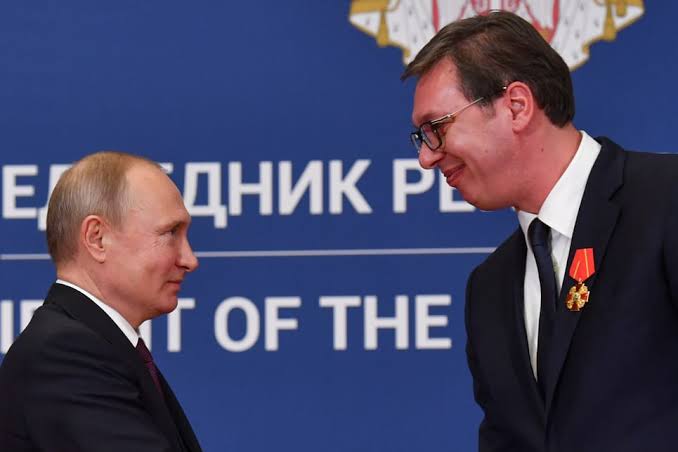 Vucic follows Putin's script to stay in power, but even the Kremlin has doubts about his success
  Alarm before elections in Serbia, former heads of security services call on police: Do not become an instrument of power
  Over 3 new soldiers in five years, Macedonia: We will continue to invest in the development and professionalization of the army
  Kurti calls on Albanians of the Presheva Valley to vote for the “Albanian Coalition”
  Government: Over 1 billion euros invested in the army in this mandate