
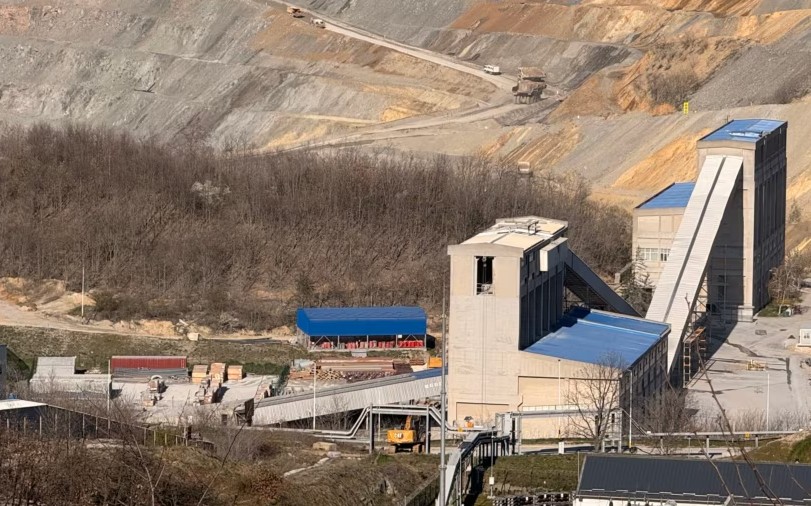
Why were the Chinese mining company Zijin and the Oil Industry of Serbia (NIS) in the working group for the development of the State Strategy for the Management of Mineral and Other Geological Resources in Serbia?
This question was raised by several non-governmental organizations and the professional public after the Serbian Parliament adopted this regulation.
The strategy, which, among other things, determines how ores will be exploited in Serbia until 2040, with projections until 2050, represents the basis for further regulations in this field.
While some in the public see Zijin and NIS's participation in the working group as a collaboration between the government and foreign companies in promoting mining at the expense of environmental protection, the Ministry of Mines and the Chinese company Zijin deny this to Radio Free Europe (RFE).
"Such participation of business entities is a normal and justified part of the broader consultative process," the Ministry states.
Ziđin told Radio Free Europe that their role in the working group was to present business experiences.
"The purpose of participation was to contribute to a better understanding of the real conditions in which mining and metallurgical companies operate," the response states.
Ziđin's participation in the working group has attracted public attention, as it is a mining giant that has been accused of environmental pollution in eastern Serbia, where the company operates copper and gold mines.
The Serbian Oil Industry, majority owned by Russia, operates the only oil refinery in Serbia and is registered by the State Environmental Protection Agency as one of the main polluters.
NIS, which is under US sanctions due to its Russian ownership, did not respond to Radio Free Europe's question about their participation in the working group.
The working group, formed by the Ministry of Mining, included, in addition to NIS and Ziđin, several ministries and state institutions, companies and professional associations.
Criticism and defense of the Strategy
Even the adoption of the Strategy in April was accompanied by criticism and opposition from some members of the professional public.
Individual members of the Serbian Academy of Sciences and Arts (SANU), gathered in the “Environment” committee, presented dozens of objections to the document.
They also claim that they were not allowed to attend the public hearing on this regulation because, as it was explained to them, there was no room.
Academic and president of this committee, Bogdan Šolaja, tells Radio Free Europe that the Ministry has accepted some of the committee's remarks, but the direction in which mining is being developed in Serbia is worrying.
"The trend of changing laws results in the adaptation of laws and accompanying bylaws, especially the inspection control apparatus, to foreign investors, not to the state. In our opinion – to the detriment of the state," says Šolaja.
Some of the objections raised by the SANU board are that the Strategy did not foresee allocations for the environment, taking into account plans for the development of mining projects, that natural parks and other protected areas are not explicitly protected from mining, and that the regulation continues the practice of “concessions” to private companies.
The environmental non-governmental organization "Right to Water" has also joined the criticism of the Strategy.
"Excessive mining growth carries huge health and environmental consequences and costs, as well as social conflicts," warns Iskra Krstić from this organization.
Krstić told Radio Free Europe that the Strategy ignores the problem of “miserable mining leases” and further facilitates obtaining mining permits.
Mining rent is a type of tax paid to the state by companies for the use of mineral resources. For years, some experts have said that mining rent in Serbia is low, which the Ministry of Mining denies.
The basis for royalties is the income the company has earned from the mineral resources used or sold.
For example, for metal ores, the rent is five percent, and for oil and gas, seven percent of revenue.
However, this mining lease does not apply to the Oil Industry of Serbia (NIS), which was sold to Russia's Gazpromneft in 2008 and at that time it was agreed that it would pay mining leases in the amount of three percent of its revenues.
In its response to Radio Free Europe/Radio Liberty, the Ministry of Mines rejects claims that the Strategy has not established a balance between mining and the need for environmental protection.
“The Strategy is based on the principle that mineral and other geological resources can only be used in a responsible, controlled and sustainable manner,” they state in their response, adding that the Strategy does not approve mining projects, but only provides a framework for the use of mineral resources.
Fear of the influence of private companies
Academic Bogdan Šolaja, in his response to Radio Free Europe, assessed that the participation of Ziđin and NIS in the working group for the development of this strategy is "bad" and that this "places the state in the position of a colony."
"It is necessary to remember that Ziđin and NIS (foreign companies), in addition to the extensive and rapid exploitation of Serbia's non-renewable resources, are extremely large polluters of the environment and have not been adequately prevented by any of the aforementioned ministries," he states.
Krstić from "Pravo na vodu" emphasizes that these companies "are among the most profitable industries in Serbia, while at the same time suffering almost no consequences due to the pollution they cause."
Ziđin has managed copper and gold mines in Bor and Majdanpek, in eastern Serbia, through two companies since 2018, when he took over a stake in Bor Mining and Smelting Basin (RTB).
This Chinese mining giant tops the list of the largest exporters from Serbia, but has repeatedly faced legal proceedings for environmental pollution.
Radio Free Europe also reported in April that the labor inspectorate had determined that Ziđin had failed to take legal measures to protect workers exposed to elevated concentrations of heavy metals for a year.
Following the adoption of the Strategy, a new Law on Mining and Geological Research is being prepared, for which Radio Free Europe/Radio Liberty's interlocutors express concern that it will further jeopardize environmental protection standards.
The Ministry of Mining did not clearly answer Radio Free Europe's question about whether Ziđin and NIS would be consulted in the drafting of this regulation, but they stated that "business entities may be consulted."
The Ministry emphasizes that this does not mean that "business entities determine legal solutions."
The Zijin company also stated that they could consult on the law “if provided for by the procedure.”
RFE/RL also wrote in 2021 that representatives of NIS and Ziđin, as well as other private companies, had participated in working groups on drafting and amending laws in the field of mining and energy in the past five years.
Lithium Use in Strategy
The Strategy for the Management of Mineral and Other Geological Resources also mentions the Jadar lithium deposit in western Serbia and says that there is a possibility of lithium exploitation “if environmental standards are met.”
The “Jadar” deposit and the mineral jadarite, a combination of lithium and boron, were discovered in 2004 in the valley of the river of the same name near Loznica, in western Serbia.
The intention of multinational company Rio Tinto to open a lithium mine in Serbia has caused a wave of mass protests in recent years.
The use of lithium is opposed by some experts and environmental associations, who state that lithium mining can have negative consequences for the environment.
Following the protests, Rio Tinto announced to Radio Free Europe in 2025 that it would remain in Serbia and that the Jadar lithium mining project was entering the “care and maintenance” phase, which includes assessing costs and resources within the project.
The European Commission has included the "Jadar" project among 13 new strategic projects related to critical raw materials in 2025.
According to estimates, the Jadar project could supply 90 percent of Europe's lithium needs.
 USA Today: Kosovo, a success story in the Balkans
  Vucic opposes conviction of Patriarch Porfirije by a Slovenian court
  Srebrenica commemorates victims on 31st anniversary of genocide
  Seselj continues his denialist propaganda about Srebrenica
  Kosovo commemorates Srebrenica victims: Without truth, there is no justice or peace
  Albania and Montenegro will close other chapters in EU accession talks on Tuesday