
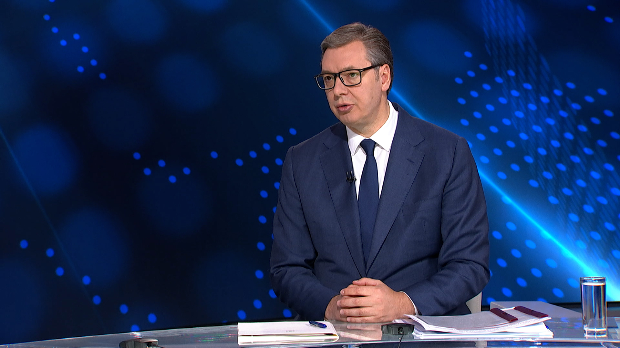
On the eve of early parliamentary elections in Serbia, scheduled for October 25, the Kosovo issue is returning to the center of political communication of President Aleksandar Vučić and the media that follow the positions of the government in Belgrade.
An example of this is the Serbian state broadcaster RTS, which in the days leading up to Vučić's trip to New York has built a significant part of its agenda around Kosovo, the position of Serbs in Kosovo, NATO's intervention in 1999, and what Belgrade presents as a violation of international law.
The political context makes this narrative particularly important. Vučić has already become the bearer of the electoral list “Aleksandar Vučić – United Serbia” and has been designated the SNS candidate for the post of prime minister. The party leaders themselves have declared that the election campaign has begun.
In this period, Kosovo once again appears as one of the topics through which the government in Belgrade builds the message about Serbia's "national interests".
In the analysis published on September 21, RTS presents Vučić's upcoming speech at the UN General Assembly as a moment to articulate Serbia's stance on Kosovo, the position of Serbs, and international law.
Vučić himself, in statements broadcast by RTS, said that in New York he will "fight for Serbia's position" and that one of the main topics will be the security and position of Serbs in Kosovo.
RTS has meanwhile expanded this framework through an analysis where Serbian commentators argue that Vučić should use his final speech at the UN as president to oppose Kosovo's independence and raise the issue of Serbs in Kosovo.
Security studies scholar Nikola Vujinovic, quoted by RTS, directly links the recent decision of the Kosovo Specialist Chambers to the possibility that Belgrade will use it in its international argument for Kosovo. RTS also presents Serbia's sovereignty and territorial integrity as a central part of this argument.
In this context, the use of Kosovo as a central topic can be seen as part of a political communication that shifts the debate from internal problems to issues of national identity, sovereignty, and relations with the West.
This is particularly evident in the way RTS constructs the story: Serbia is presented as a party defending its territory, Serbs in Kosovo as a community under pressure, while NATO’s intervention in 1999 and Kosovo’s independence are placed within a broader narrative about the “double standards” of Western powers.
Kosovo as an electoral mobilizer
For a nationalist electorate, the Kosovo issue has a special political weight. Therefore, its return to the center of public communication on the eve of the elections could serve as an instrument for mobilizing national identity and consolidating the electorate that considers Kosovo a matter of fundamental Serbian state interest.
The very name of the ruling party’s list – “Aleksandar Vučić – United Serbia” – places the candidate and the concept of national unity in the same political framework. In early September, the SNS unanimously decided that Vučić would be the party’s candidate for prime minister, and party leaders declared the campaign open.
In this context, a message built around “defending Serbia,” “defending Serbs in Kosovo,” and opposing what Belgrade calls international injustice creates a direct symbolic link between the leader and the national issue.
Another important element is the role of RTS in this process.
In its analysis, the public broadcaster gives considerable space to commentators who support Belgrade's framework for Kosovo. At the same time, the positions of Kosovo institutions and the counterarguments of international actors are presented in a much more limited way.
This becomes even more apparent when RTS quotes Vujinovic as saying that Kosovo and the position of Serbs should be at the center of Vučić's speech at the UN and that Serbia should insist on its sovereignty and territorial integrity.
The narrative does not stop at Kosovo.
RTS links it to NATO's intervention in 1999, to Serbia's relations with Russia and the United States, as well as to Belgrade's relations with the European Union.
In this way, a broader political framework is created: Serbia is presented as a state that must protect its interests in an international system that, according to the transmitted narrative, has applied different standards to it.
On the eve of the October 25 elections, the return of Kosovo to the center of Serbian political discourse gives Vučić a topic that goes beyond the usual debate on the economy, governance, or domestic protests.
It places him in the role of a leader who, according to his political message, defends Serbia, Serbs in Kosovo, and state interests in the face of international pressure.
Precisely for this reason, Vučić's speech at the UN and its coverage by RTS can also be read in function of the electoral climate in Serbia: not only as foreign diplomacy, but also as political communication at a moment when Vučić is seeking a new mandate through his electoral list.
In this context, Kosovo remains one of the most powerful symbolic instruments of Belgrade's policy.
And the fact that this topic is intensifying precisely in the weeks before the elections makes it reasonable to ask whether the narrative about Kosovo is being used not only for diplomacy, but also for political and electoral mobilization of the nationalist base.
The GeoPost
 Hashim Thaçi's lawyer: The three Special Judges smeared the KLA and NATO
  Pettifer: Kosovo should review its relationship with EULEX and international missions after the Hague verdict
  Miketic: Preparations are being made to steal elections in Serbia through voters registered in Kosovo
 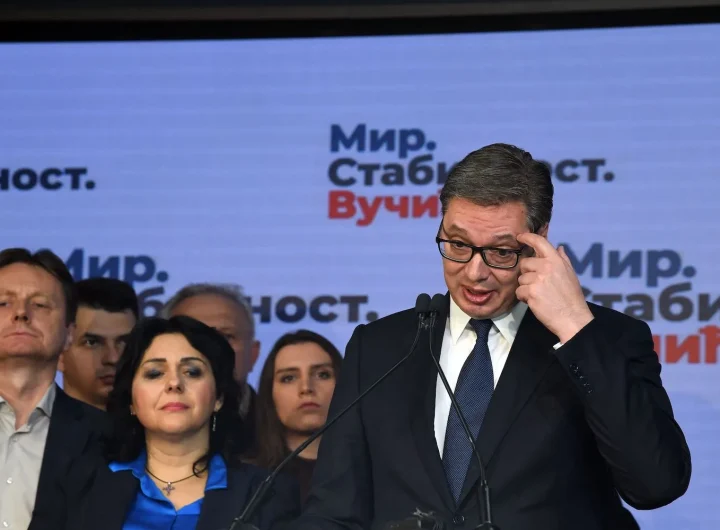 Vučić's fear of losing power, Russia comes to his defense before the elections
  Strong signal from Brussels for Vučić, von der Leyen bypasses Serbia
  There are countless Srebrenicas in Kosovo, committed by Serbs.