
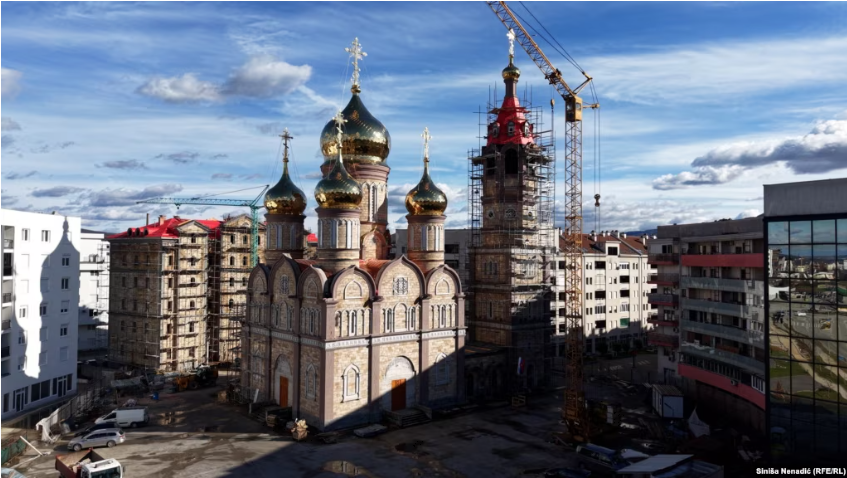
There are about 40 Orthodox religious buildings in the Banja Luka area.
Construction of the Russo-Serbian church in Banja Luka has been ongoing for eight years, with constantly postponed deadlines and ongoing allocations from the Republika Srpska budget. The final cost and completion date of the project, which the entity's authorities promoted as a landmark for Russian-Serbian relations, are unknown.
According to data published on the government website, around 2 million euros were allocated during the first two years of construction. In 2024, an additional 5 million euros were approved, and with the latest decision in February of this year, another 2.5 million euros were allocated. This brings the total amount of public funds close to 10 million euros.
The latest allocation to continue the work comes in a year when the Bosnia and Herzegovina entity plans to borrow nearly 1 billion euros to repay previous debts and unpaid social benefits. There is also no information on how much the Serbian Orthodox Church or private donors have contributed to the construction.
The Banja Luka Eparchy does not have a publicly available email address and no one answered the listed phone numbers. There are about 40 Orthodox religious buildings in the Banja Luka area.
The project is being carried out by the Eparchy of Banja Luka, with financial support from the Government of Republika Srpska. Construction of the church began in 2018. It is designed as a replica of the Chudov Monastery in the Moscow Kremlin, which collapsed after the October Revolution.
When the project was presented, it was announced that the church would be dedicated to the Russian imperial Romanov family and Tsar Nicholas II, as a symbol of gratitude to Russia for its support of the Serbian people during World War I.
The building is being constructed according to a project by the Moscow Architectural Institute, and the work is being carried out by Russian and local artisans.
From the beginning, authorities described it as a historic project in Russian-Serbian relations. In early 2019, the church was included among the budget priorities, with an 18-month completion deadline announced at the time. Since then, the deadline has been extended twice, before the 2022 and 2024 elections.
The church and an accompanying cultural center are being built in the wider city center of Banja Luka, not far from the Republika Srpska Government building, on an area of about 6,500 square meters. The cultural center is planned to host Russian language studies and programs related to Russian culture.
In addition to the Eparchy of Banja Luka, the project was initiated by representatives of the humanitarian organization the Imperial Palestinian Orthodox Society, headed by Sergei Stepashin, former prime minister of Russia and former head of the Federal Security Service, the successor to the KGB.
While the church remains among the budget priorities of Republika Srpska, numerous infrastructure projects in Banja Luka are still awaiting funding. These include investments in roads, water supply networks, bridges and educational facilities, for which the city says it lacks sufficient resources.
A few years ago, a bust of Nicholas II Romanov was installed in the center of Banja Luka at the initiative of the Palestinian Imperial Orthodox Society. A bust of the former Russian tsar also stands near Doboj, in northern Bosnia and Herzegovina. It was inaugurated in 2017, organized by the Serbian-Russian Association of Friendship and Unity of Orthodox Peoples, with the support of the Russian Embassy in Bosnia and Herzegovina.
Not far from the Russian-Serbian church, also near the entity's Administrative Center, is the building housing the office of the Russian Embassy in Bosnia and Herzegovina, opened in June 2024. The villa, owned by the Serbian Orthodox Church, Eparchy of Banja Luka, was built during the Austro-Hungarian period and is one of a series of villas erected at that time along the main street of Banja Luka, then known as the Imperial Road. The building that now houses the Office of the Russian Embassy is part of an architectural ensemble declared a national monument of Bosnia and Herzegovina by a decision of the Commission for the Preservation of National Monuments in October 2017.
With the opening of the Office, Bosnia and Herzegovina became the only country in the Western Balkans where the expansion of Russia's diplomatic mission was enabled after this country launched its aggression against Ukraine in 2022. This move was announced at the time as a continuation of the policy of proximity between Banja Luka and Moscow.
Russia has so far given strong support to Milorad Dodik, the president of the Alliance of Independent Social Democrats, who through statements and decisions of the authorities he leads has increasingly expressed separatist aspirations to separate Republika Srpska from Bosnia and Herzegovina.
Since the beginning of Russia's aggression against Ukraine in February 2022, Dodik has met with Russian President Vladimir Putin nine times. Dodik met with Putin in his capacity as a member of the Presidency of Bosnia and Herzegovina and as President of Republika Srpska, most recently on October 2 last year in Sochi, after his mandate as President of Republika Srpska was revoked.
Since 2011, Russia has regularly opposed the High Representative's reports to the United Nations Security Council, stating that this position should be removed. / Free Europe /
 Criminal Ratko Mladic in poor health, close to death
  Stradner: US resolution on Kosovo in NATO is a "strong political signal"
  OSCE: The espionage case against Djukanovic is an individual matter, we respect the court's decision
  Three Congressmen Present Resolution in US Congress in Support of Kosovo's Membership in NATO
  Vučić openly threatens: We will fight against Kosovo's membership in NATO
 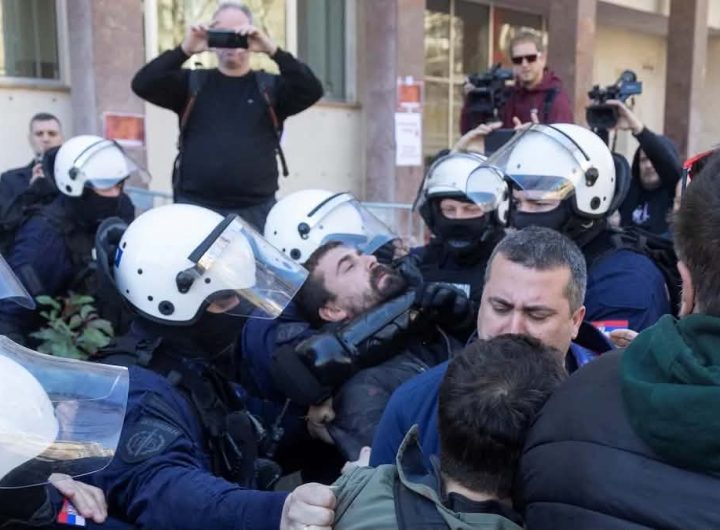 "Violence and threats", Serbia sinks in the Press Freedom Index, the weakest in the Western Balkans