
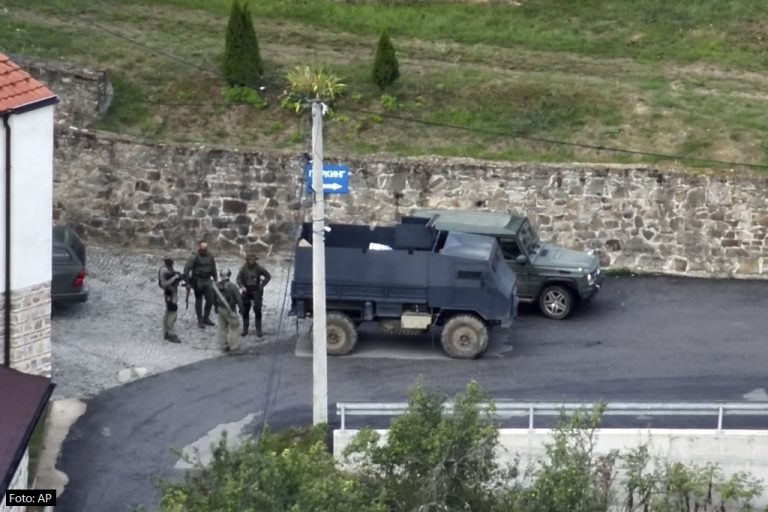
During the year before the attack in Banjska, northern Kosovo was a tense area with an increased presence of Serbian parallel structures and criminal groups associated with them. The Kosovo Government’s decision to convert illegal Serbian license plates escalated through disobedience, abandonment of institutions, the setting up of barricades, and violent protests by groups of Serbs in northern Kosovo.
Serbia, through political discourse, supported or did not distance itself from these actions, while the Serbian List and figures like Milan Radoićić played a key role in organizing resistance structures against the Kosovo authorities.
In November 2022, the mass resignation of Serbs from Kosovo institutions marked the beginning of institutional paralysis in the north. This left a security and governance vacuum that was exploited by parallel structures and organized criminal groups, often linked to influential Serbian politicians and businessmen in Belgrade.
Despite public statements of support for dialogue with Kosovo and verbal acceptance of the Basic Agreement in March 2023, Serbia has refused to sign and fully implement it. At the same time, it has intensified its rhetoric against Kosovo's statehood, accompanied by a campaign of aggressive international diplomacy and indirect support for destabilization on the ground.
The Serb boycott of local elections in the north (April 2023) created an anomalous situation: institutional power without local legitimacy, which was then used by Belgrade as an argument to challenge the authority of Albanian mayors. This development was accompanied by violent protests in May 2023, where dozens of KFOR soldiers were injured.
During the summer, there were reports of weapons accumulation, paramilitary training, and unusual movements in northern Kosovo, especially in the area of the village of Banjska. These activities took place in silence, with indications of logistical support from figures connected to Serbian structures – as later confirmed by the involvement of Milan Radoičić.
On September 24, an organized, armed and trained Serbian group launched a well-coordinated attack on the Kosovo Police in the village of Banjska. During the terrorist attack, police sergeant Afrim Bunjaku was killed, while fierce fighting took place between Kosovo special forces and the attackers, where three of the aggressors were killed and others retreated.
Arsenals of military weapons, armored vehicles, and high-level military equipment were seized. State leaders condemned the attack, calling it an aggression against the state of Kosovo.
This was not a sporadic incident, but a planned terrorist operation, aimed at challenging Kosovo's sovereignty and provoking a wider conflict.
The identification of Milan Radoićić as the leader of this group, and his public admission of organizing the attack, raised serious suspicions of indirect involvement by official Belgrade, or at least tolerance of its activities.
The attack was also condemned as a terrorist act by the US, EU and NATO, while appealing to Serbia to cooperate in the investigation.
Analysis:
The terrorist attack of September 24, 2023 in Banjska i Zvecan is the most dangerous point of escalation of tensions in northern Kosovo since 2004.
This attack was not a local incident, but a well-planned act with political and military motives that aimed to set a precedent of destabilization, perhaps to create a de facto autonomous zone, similar to the Donbas model in Ukraine.
This attack strengthened Kosovo's arguments about the danger of parallel structures in the north.
To make it clearer that Serbia is behind the aggression in Banjska, Zvecan, we recall what Serbian media outlets close to Serbian President Aleksandar Vucic reported. They treated the terrorist attack in Banjska primarily as a tragic incident and an act that highlights the deep tensions in northern Kosovo.
Reports by RTS (Serbian State Television), tabloids Alo, B92, Gazeta “Veqernje Novosti”, Kosovo Online built a narrative towards the events in Banjska, which differs fundamentally from that of the Kosovo authorities and international media. Moreover, pro-Russian media close to Vucic such as Sputnik, Informer and RT Balkan emphasized, as they wrote, the “harsh US/EU reaction towards Serbs”, accusing the West of “never calling Albanians who kill Serbs terrorists” and that “they shout more for one Albanian policeman than for hundreds of killed Serbs”.
Using the media as a strategic tool for political and psychological influence in the region and on the Serbian public, avoiding words that could label armed groups as terrorists, protecting key figures like Radoićić, minimizing the role of Serbian groups in organizing the attack, presenting it as a reaction to "pressure and discrimination of Serbs in the north." /The Geopost/
 Vučić admits failure after 14 years in power
  Who is Milan Knežević, the pro-Serb politician in Montenegro who is calling for the "denial" of Kosovo?
  Kosovo's NATO Integration: Why the 'Gray Zone' is No Longer an Option
  “Doppelgänger”: Media cloning in the service of propaganda and the danger for the Balkans
  How Russia is using disinformation and cyberwarfare to destabilize Europe
  JULY'S BLUFF: Vučić's choice between risking defeat now and collapse later