
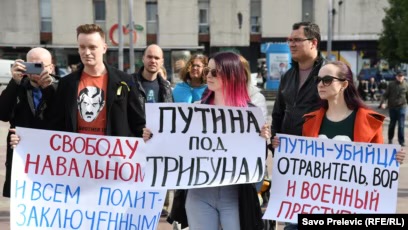
Russian citizen, Samvel Mnatsakanyan, moved to Montenegro immediately after the invasion of Ukraine began, as he opposed the war.
"At first, I was really enthusiastic about Montenegro and for a long time I thought I was very lucky to be here," he says.
However, due to Podgorica's decision to impose visas for Russian citizens, Mnacakanjan plans to leave Herceg Novi, where he has lived for four years.
"The temporary residence permit is valid for one year. When it expires, I have to cross the border, return to Montenegro and apply again. But I won't be able to come back because I will need a visa. That's the problem," he explains.
He has already resigned from the school where he worked and is considering moving to neighboring Serbia, where he does not need a visa.
According to the latest population census, conducted in September 2024, Russians are the most numerous foreign citizens with permanent residence in Montenegro.
Data sent to REL by the Ministry of Internal Affairs of Montenegro shows that almost 18 Russian citizens have temporary residence permits, while more than two thousand have permanent residence permits.
Montenegro is the first country in the region to lift the visa-free regime for Russian citizens.
The European Commission has been calling for several years on the countries of the Western Balkans, including Montenegro, to harmonize their visa policies with European Union rules, to reduce the risk of irregular migration and misuse of the visa-free regime.
In addition to Russian citizens, citizens of Belarus, Turkey, China and Saudi Arabia will no longer be able to travel to Montenegro without visas.
The changes come into effect on November 1.
With this, Montenegro has fully harmonized its visa policy with that of the EU, the country's Ministry of Foreign Affairs announced.
The ministry also said that, at the same time, "measures are being taken" to make the process of obtaining a Montenegrin visa as simple and accessible as possible.
Russian ambassador summoned for talks
The Russian embassy in Montenegro sees the imposition of visas as "hostile actions."
This embassy announced that it considers the introduction of a visa regime for Russian citizens "another proof of Podgorica's extreme dependence on the influence of its foreign sponsors, who are far from putting the interests of their Montenegrin partners first."
For this, but also for an editorial criticizing the imposition of sanctions against Moscow, the authorities in Podgorica summoned the Russian ambassador, Aleksandar Lukashik, for a conversation.
They said that these are assessments that exceed the limits of ordinary diplomatic communication and are not in line with the principles of mutual respect.
Montenegrin authorities also said that the full harmonization of visa policy with that of the EU is a sovereign decision of the state, taken in accordance with national interests and obligations arising from the European integration process, and that it is not directed against Russian citizens.
Podgorica, following EU policy, has also imposed a series of sanctions on Moscow for its aggression against Ukraine. These include freezing the assets of some Russian citizens in Montenegro, as well as banning the activities of Russian state media.
In March 2022, Moscow included Montenegro on the list of foreign states that "take hostile actions against Russia, Russian legal entities and individuals."
During that period, Montenegro expelled five Russian diplomats, while Russia, as a countermeasure, declared a Montenegrin diplomat in Moscow persona non grata (persona non grata).
Visa imposition also affects the Russian diaspora that is against the war
The visa-free regime was one of the reasons why the Russian diaspora against the war was formed in Montenegro.
Russian citizens who do not have a residence permit can currently stay in Montenegro for up to 30 days. After that, they can do a so-called “visa run” – leave the country and immediately return to benefit from a new 30-day stay.
However, this will no longer be possible from November 1st.
According to Samvel Mnatsakanjan, Montenegro's own plans for EU membership have significantly impacted the Russian diaspora in this country.
In parallel with preparations for the introduction of visas, the authorities have in some cases tightened the rules for obtaining a residence permit.
"I gradually realized that Montenegro is not inclined towards us. They do everything to prevent us from staying here for a long time," said Mnacakanjani.
As rumors of a possible new mobilization are spreading again in Russia, the number of people seeking to leave the country is likely to increase, estimates Anastasia Burakova, a Russian human rights activist.
"Now, among the [European] countries where Russians can enter without a visa and which have fairly liberal migration rules, there are only Armenia, Georgia and neighboring Serbia left," she points out.
Burakova is also the founder of the organization "Kovcheg", which helps Russians who are at risk of persecution or who have fled the country due to opposing the war.
What do the Montenegrin authorities say?
The Ministry of Foreign Affairs of Montenegro announced that it is "intensively and systematically" undertaking activities that will mitigate the potential negative effects of these changes.
It has been explained that, to facilitate the procedure, applications for a Montenegrin visa in the future will also be able to be submitted at VFS Global visa centers, and not only at the diplomatic and consular representations of Montenegro.
The ministry also announced the creation of a new Visa Information System, harmonized with EU systems and Schengen security standards, with the aim of introducing electronic visas.
Montenegrin economist Stevan Gajevic estimates that electronic visas will not "automatically solve the problem."
"The administrative barrier does not cease to be a barrier just because it has been moved from the counter to the screen."
"Therefore, it is imperative to create a fast, predictable and affordable visa system, with clear deadlines and rules that tourists will know in advance," he concludes.
What could be the negative consequences for the country?
The Montenegrin government has so far justified the practice of not fully harmonizing with EU visa policy with economic interests in tourism – revenues from this sector account for about a quarter of Gross Domestic Product (GDP).
During 2025, Montenegro was visited by over 2.7 million tourists.
Of the total number of overnight stays, 95.8 percent were made by foreign tourists, data from the Statistical Office of Montenegro show.
Russian tourists are the second largest in number, right after visitors from Serbia. As for Turkish citizens, in both 2024 and 2025, the number of arrivals to Montenegro was over 100 thousand.
Montenegrin economist Stevan Gajevic explains that Montenegro's tourism offer has been adapted for years to guests from Russia, Turkey, the region and other markets, whose tourists stay longer, use private accommodation, buy real estate and have significant consumption in the local economy.
"It is unrealistic to expect such markets to be replaced overnight with tourists from the European Union, whose habits, expectations and consumption structure are often different. Such a reorientation would require years of investment, learning and adaptation of the offer," he estimates.
He adds that Montenegro "must carefully consider any European decision before automatically accepting it."
"Not because we should question the European path, but because we are not sure that all common policies are equally beneficial for all countries," he says.
According to him, the introduction of visas is not only an administrative change, but also "an economic and geopolitical decision with potentially serious consequences."
"We will limit access precisely to those markets on which our tourism, air transport, trade and real estate market depend to a large extent," says Gajevic.
The Ministry of Economic Development and the Ministry of Tourism did not respond to REL's questions regarding the possible consequences that the introduction of visas could have on the Montenegrin economy, as well as the measures that will be taken to mitigate them.
Citizens of countries for which visas are imposed in Montenegro
In Montenegro – a country with around 620 thousand inhabitants – there are around 100 thousand foreign citizens registered with residence permits, most of whom are Russians.
There are also just over 10 Turkish citizens in the country with temporary residence permits or work permits, while 103 of them have permanent residence permits.
According to the results of the 2023 population census, just over 1.800 citizens of Montenegro declared themselves as Turks.
As for Chinese citizens, around 500 of them have temporary residence permits, while just over 100 have permanent residence permits.
The Statistical Office of Montenegro recorded an increase in the number of their visits in 2025 – over 82 thousand – surpassing the previous record of 2019.
However, Chinese citizens have not previously been able to stay in Montenegro without a visa individually, but this was made possible through group tour packages organized by travel agencies.
Belarusian citizens with temporary residence permits in Montenegro currently number slightly less than 900, while 96 have permanent residence permits.
Two Saudi Arabian citizens also have temporary residence permits, while none have permanent residence permits.
Allegations of abuse of the visa-free regime
The European Border and Coast Guard Agency, Frontex, warned at the end of June that citizens of China, Russia and Turkey continue to enter the Western Balkans without visas and then try to continue their journey towards the European Union.
At the same time, Brussels is urging countries in the region to tighten visa policies and close the space for such abuses.
With the introduction of visas, Montenegro fulfilled one of the final criteria for closing Chapter 24 of the EU accession negotiations – Justice, Freedom and Security – as well as one of the key obligations of the Reform Agenda.
Podgorica is considered to have the best chance of becoming an EU member by the end of this decade, having provisionally closed 18 out of 33 chapters of accession negotiations.
 Without a roadmap to the EU: What else does Serbia risk losing?
  Ukraine's Operation Vivaldi thwarts Russian plan to encircle Donbas
  The accused in the terrorist attack in Banjska, Milan Radoićić, appears at the SNS pre-election rally with Vučić's son
  US imposes sanctions on Hague Tribunal, Rubio: We will paralyze it
  How did Iranian operatives use AI to spread fake news in American media?
  Montenegro to deport head of network linked to Russian hybrid operations, Rybar