
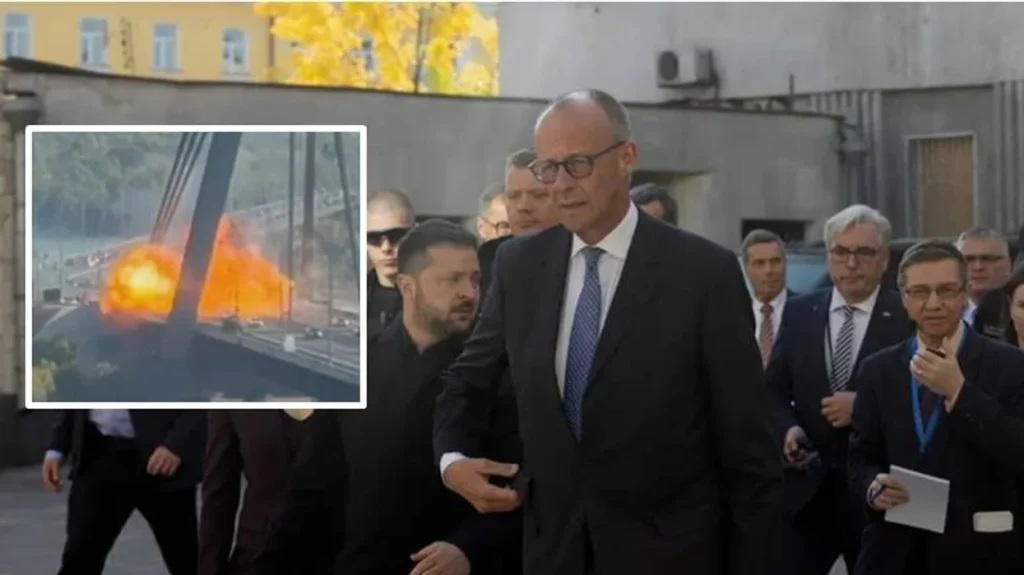
Russia hit another key bridge in Kiev on Sunday, shortly after the German chancellor arrived for a surprise visit to show European support in the face of increasing attacks.
Air raid sirens sounded continuously in the Ukrainian capital throughout the morning, including as Friedrich Merz met with President Volodymyr Zelensky at the National Academy of Sciences, which had been hit by a Russian attack drone on Tuesday.
Zelensky told him that people in Kiev were experiencing "terrible nights and days" due to the incessant attacks and called Ukraine's Russian opponents "real barbarians."
"Here we can see the whole futility of this war," Merz noted.
"These barbaric attacks on the civilian population of Ukraine must stop. These are war crimes that are being committed here every day."
Kiev Mayor Vitali Klitschko said an attack had damaged the road surface on the Northern Bridge - one of several bridges connecting the eastern and western parts of the city over the Dnieper River that have been hit in recent days.
Footage posted on communication channels showed a missile hitting the structure, causing a powerful explosion of fire just as vehicles were passing over it.
Klitschko has said that Kiev - largely spared the devastation caused near the front lines during the conflict - must now move to a state of war due to the increase in attacks.
A wave of incessant attacks has hit residential areas, gas stations, schools, and rail and communication infrastructure, while air raid sirens, which sound almost constantly, disrupt daily life and create anxiety among people.
Upon arrival, Merz said that Ukraine "needs all our support in the coming weeks."
"If Russia is not stopped, its war machine will sooner or later turn against us," he added.
Ukraine is seeking more Western military support, including advanced interception systems to shoot down new Russian high-speed, jet-powered drones.
Meanwhile, on Sunday, Zelensky promised "important agreements."
Government sources in Berlin said they were expected to give their support to a new military support package worth more than $1 billion.
It includes combat drones and satellite technology to help Ukraine strike Russian launch sites, as well as for the joint production of anti-aircraft drones, German sources said.
"This support addresses the most significant current gap in Ukraine's air defense system. The impact is expected to be rapid and tangible," a source said.
 After being expelled from Montenegro, the founder of the Russian network Rybar arrives in Serbia
  Without a roadmap to the EU: What else does Serbia risk losing?
  Ukraine's Operation Vivaldi thwarts Russian plan to encircle Donbas
  The accused in the terrorist attack in Banjska, Milan Radoićić, appears at the SNS pre-election rally with Vučić's son
  US imposes sanctions on Hague Tribunal, Rubio: We will paralyze it
  How did Iranian operatives use AI to spread fake news in American media?