
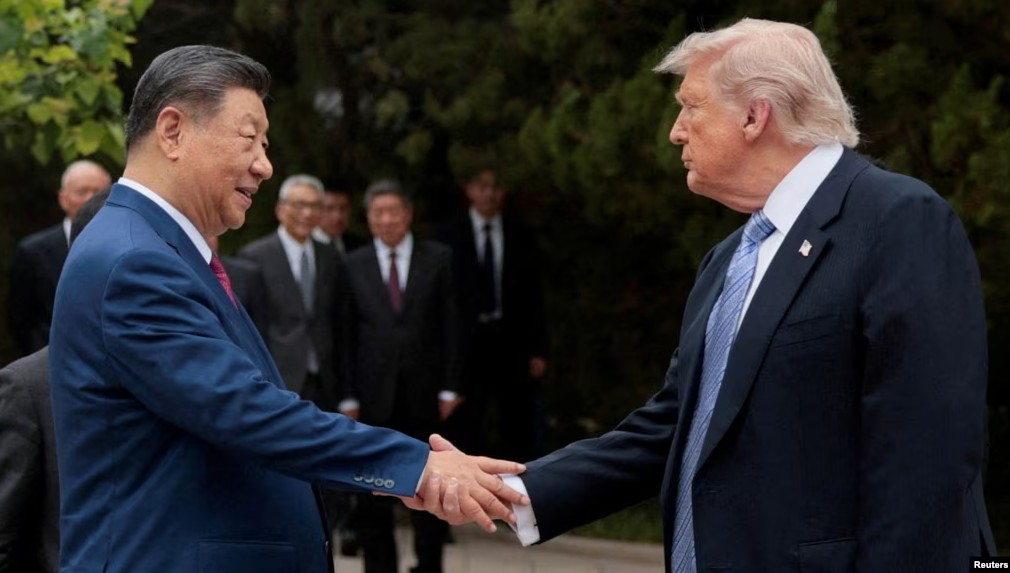
Ahead of a high-stakes US-China summit scheduled for September 24 at the White House, Beijing appears to be focusing its influence on Iran to gain leverage during negotiations with its main geopolitical rival.
Expectations for a U.S.-China breakthrough on Iran at the upcoming summit in Washington are low. Trump has signaled a focus on economic outcomes for this meeting with Xi, and the Chinese leader has responded by assembling a delegation of top business executives.
But, on the eve of the meeting, Chinese Foreign Minister Wang Yi met with his Iranian counterpart Abbas Araghch in Beijing on September 16. The meeting was the fourth time the two men have spoken in the past three months.
During their meeting, Wang noted that Beijing and Tehran are "comprehensive strategic partners," an asymmetrical relationship that favors Beijing.
China is Iran's largest trading partner and the destination for over 80 percent of its seaborne oil exports, according to commodity analytics firm Kpler. However, Iran accounts for only 1 percent of China's overall global trade, according to Chinese government data.
China, Wang said, "is also willing to strengthen dialogue and cooperation with Iran and safeguard Iran's legitimate rights and interests."
The Chinese foreign minister called on “all parties” to take measures to quickly “reopen” the Strait of Hormuz – a waterway that before the US-Iran war was the route for about a fifth of global oil and gas supplies – but stopped short of exerting direct pressure on Iran.
He did not offer a concrete mediation plan either.
"China is not going to do the heavy lifting" to bring the US and Iran back to the negotiating table, Elizabeth Freund Larus, a senior associate fellow at the Pacific Forum think tank, told Radio Free Europe.
She noted that China benefits geopolitically from the conflict's impact on American military resources, even as Beijing faces economic pressure from higher energy and raw material costs.
The Iran war has cost the Pentagon more than $38 billion as of August 1, according to the Congressional Budget Office.
Moreover, in recent months, Washington has diverted significant military assets from the Indo-Pacific region to the Middle East. The United States now does not have an aircraft carrier deployed in the Western Pacific for the first time since World War II, worrying American allies wary of China's massive military buildup.
At the same time, Beijing is grappling with rising oil prices. Shanghai crude futures hit a record 929.4 yuan ($137.80) per barrel this month after Iran-backed groups launched drone attacks that damaged Saudi Arabia's East-West pipeline.
To some extent, China's strategic stockpiling of oil helps protect it from price increases.
The US Energy Information Administration (EIA) estimates that Beijing injected an average of 1.1 million barrels per day into its national oil reserves last year, giving it a total of 1.4 million barrels as of December 2025. That's three times larger than America's Strategic Petroleum Reserve.
However, the buffer provided by the reserve only goes so far.
Bill Bishop, a Washington-based China expert and commentator, noted in the September 16 issue of his Sinocism newsletter that “the global economic impact of another big increase in petrochemical prices would hurt the export markets that China’s economy needs.”
“China certainly wants the war to end — a higher oil price is in no one’s interest, but the question is who should bear the cost of ending it?” Yun Sun, director of the China Program at the Stimson Center in Washington, said in an interview.
“If China were to put pressure on Iran, it would raise the question of what the US and Iran would do to de-escalate tensions and stabilize the situation, as well as meet Iran’s need for security. So far, there has been very little restraint in this regard.”
Aiding Iran's war efforts
While China is officially neutral in the Iran war, it has provided significant support to Tehran.
The key point is that Beijing’s massive purchases of Tehran’s oil have provided an economic lifeline for the beleaguered Iranian regime. To circumvent punitive U.S. sanctions, China uses a covert trading mechanism similar to a barter, according to Reuters. Since the transactions do not go through the Western-dominated global financial system, they evade U.S. oversight.
The administration of US President Donald Trump has repeatedly pressured China to cooperate with sanctions on Iran. After the administration intensified those sanctions in late August, Treasury Secretary Scott Bessent warned that those who “enable” Tehran should not “deduct the cost of testing Washington.”
The US has several options to force China to cooperate better on sanctions against Iran.
The first is the blacklisting of independent Chinese oil refiners that have purchased large quantities of Iranian oil. So far, Washington has sanctioned five such firms. Washington has also sanctioned dozens of Chinese-linked firms and shipping vessels for maritime trade with Iran.
These measures have caused significant trade barriers and pressure for compliance.
However, Iran and its Chinese buyers can evade sanctions. Tehran uses a so-called “shadow fleet” of old oil tankers and shell companies to secretly export oil. Beijing has also ordered its companies not to comply with U.S. sanctions.
However, Washington has a more significant economic weapon in its arsenal: dominance of the global financial system. The Trump administration could ban Chinese state-owned banks that violate sanctions from using the dollar. This move would have a devastating effect on China's economy.
However, given the significant US-China economic relationship, “the broad imposition of sanctions on China’s financial institutions could be very damaging to the US economy as well,” Taipei-based lawyer and political risk consultant Ross Darrell Feingold said in an interview.
At the same time, American financial firms operating in China are likely to be subject to harsh Chinese retaliation.
If the Trump administration is seriously considering sanctions on major Chinese banks, "these financial institutions will make their concerns known to the White House," he says.
Part of Beijing’s reasoning for challenging the sanctions relies on its interpretation of international law. “There is no UN sanction against normal trade between China and Iran,” says the Stimson Center’s Sun newspaper, adding, “And China does not accept the legality of unilateral US sanctions.”
For Washington, one of the most worrying aspects of China's pro-Iran stance is that it extends to the military realm.
“China plays a critical, but often overlooked, role in supporting Iran’s defense industrial base,” Mike Kuiken, vice chairman of the U.S.-China Economic and Security Review Commission, said in a July statement. That role includes providing components for Iran’s Shahed drones and ballistic missiles, as well as sodium perchlorate, a chemical needed for rocket fuel. Tehran uses China’s BeiDou satellite navigation system to guide military operations.
Beijing denies that it supports Iran militarily or provides it with intelligence.
China's approach to supplying Iran with dual-use equipment (which has both commercial and military applications) as well as Iranian access to Chinese satellite navigation technology "has been shaped by a tension between Beijing's interest in supporting Iranian capabilities in key areas and its desire to minimize potential consequences," John Van Oudenaren, a research analyst for technology consultancy BluePath Labs in Washington, told Radio Free Europe.
China is wary of risking further major US sanctions on Chinese entities or a deterioration in relations with Washington and its allies, he added.
Continuous blocking
In recent weeks, Trump has downplayed Beijing's close ties with Tehran, telling reporters at the White House on September 4 that "they [China] are not really involved" in the Iran war. Trump has previously said that Xi promised him that China would not supply Iran with military equipment.
"Maybe they [Trump and Xi] will have a calm discussion about the value of sanctions" when they meet, Carice Witte, an Israel-based China expert and executive director at the think tank SIGNAL Group, told Radio Free Europe.
At a Hudson Institute event on September 17 in Washington, Nick Snyder, a nonresident senior fellow at the organization and former senior State Department official, said that “the Chinese want to have the same value as their pie” in the Middle East by keeping Iran as a client state while having good relations with the Gulf countries.
This strategy is becoming unsustainable as the war continues, he said.
For Beijing, “ending the war is not worth supporting a U.S. position,” Witte says. “China’s biggest goal is to distance itself from the U.S. and discredit the U.S..”
 Over 3 new soldiers in five years, Macedonia: We will continue to invest in the development and professionalization of the army
 Kurti calls on Albanians of the Presheva Valley to vote for the “Albanian Coalition”
 Government: Over 1 billion euros invested in the army in this mandate
 Scandal in Vienna: KRIK uncovers Vučić-linked network suspected of manipulating Serbian diaspora voters
 US declares Chinese Confucius Institutes a national security threat
 SERBIA OR MAFIA