
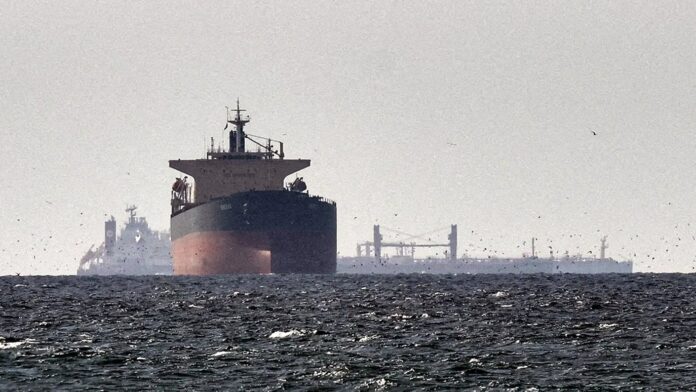
The Iran framework deal provided an immediate boost to markets, with stocks rising and oil prices falling. But whether this translates into lasting economic benefits will depend largely on shipping traffic in the Strait of Hormuz.
There were signs that maritime traffic was starting to revive on June 18, in the early hours after the signing of a memorandum of understanding between the presidents of the US and Iran aimed at ending the war, according to maritime data company Windward.
Speaking at an online conference, Windward's chief analyst, Michelle Wiese Bockmann, said 18 ships had passed through the Strait of Hormuz between 6pm on June 17 and 2pm on June 18, in what she described as "a sign of confidence in the deal".
According to her, specifically, it concerns a French-flagged liquefied natural gas (LNG) tanker, two Hong Kong-flagged tankers, an Italian-flagged vehicle carrier, a Japanese-controlled oil tanker and several Saudi-flagged tankers.
Ten of the ships emerged from the strait, having been stranded in the Persian Gulf for 109 days due to the war that began with US and Israeli air strikes on Iran on February 28.
Before the war, about 20 percent of the world's oil supplies passed through the Strait of Hormuz, as well as large quantities of LNG, fertilizers, and other important products and goods.
“A slow stream of ships”
"It will start as a slow trickle, but this is definitely a very good sign, a signal that there is confidence in the transitions," Bockmann said.
“Currently, the crossings were averaging about seven ships per day in the first two weeks of June, until we got the news about this deal coming [on June 14]. And, the total volume of crossings so far in June already exceeds the 156 we recorded in May. We are seeing everything picking up,” she added.
Ben Cahill, a non-resident senior fellow at the Atlantic Council's Global Energy Center, said this "flow" must increase if an economic peace dividend is to be achieved.
"It's all about tanker traffic. Paper agreements don't matter much if they don't actually restore the movement of oil through the Strait of Hormuz, because that's what everyone will be monitoring - the number of tankers coming out of the strait to transport oil, gas and other products to market," he told Radio Free Europe.
"But also the entry of tankers into the strait, because that is when normal shipping operations will resume and oil and gas production throughout the Middle East can also resume. Two-way tanker traffic should be monitored," he added.
This is a real test. Shipping companies need to be confident that, if their ships enter the Persian Gulf, they will not be blocked again by a new outbreak of hostilities. This is essential for the resumption of oil tanker loading from ports in Iraq, Kuwait and Saudi Arabia, as well as for the transport of LNG from Qatar.
Under the deal, Washington has also issued a waiver for sanctions on Iranian oil, giving it another potential economic boost.
Windward has also tracked Iranian ships moving through the strait, as well as Iranian-controlled oil and LNG tankers, which the company says are moving westward from Southeast Asia through the Strait of Malacca – seemingly certain to be loaded at Iranian ports now that the US naval blockade of Iranian ports and waters has been lifted.
First test at sea
But, this situation will be in effect for as long as the agreement exists.
"There is an element of testing in all of this," Naysan Rafati, Iran analyst at the International Crisis Group, told REL.
"The first test is at sea. Will traffic in Hormuz start to gradually increase? Will the Iranians continue to harass or launch drones at ships? Will the US allow Iranian ships to pass through the cordon?" he added.
Other key tests for the functioning of the strait include ship security, the presence of naval mines, and the issue of tariffs.
The text of the US-Iran memorandum states: "The circulation of commercial vessels will begin immediately and, taking into account the need for the removal of technical and military obstacles as well as the removal of mines by the Islamic Republic of Iran, will be fully established within 30 days."
But, at this stage there are no details on when the mine clearance will begin and who will carry it out.
The agreement also says that Iran has accepted tariff-free passage through the Strait of Hormuz for 60 days, pending further talks with US negotiators.
Bockmann said the southern route through the strait is in Omani waters and that once the mines are removed, the issue of tariffs will become irrelevant. Tehran has talked about setting “maritime service tariffs” in cooperation with Oman, but Bockmann said “I don’t think that will be accepted.”
Regarding marine insurance, she told Radio Free Europe that it is "still too early to say" whether costs will start to decrease.
"We know that the additional insurance, which is part of the war risk for entry into the so-called listed areas, is being recalculated every day. It is a percentage of the value of the ship. Before the war, it was less than 1 percent of the value of the ship. Then we saw it increase to 3 to 5 percent and sometimes up to 10 percent," she said, adding that the return to lower marine insurance will be important for the restoration of normality in maritime transport.
Cahill said he doesn't expect marine insurance costs to decrease anytime soon, but according to him, that's not the key problem.
"The problem was that ship owners just didn't want to risk their crews. When they have that certainty, that sense of security, that conviction that it's okay to go through again, I think you'll see a pretty quick result," he said.
The end of Hormuz?
Iran blocked traffic through the strait in response to US and Israeli air strikes that triggered the war on February 28. The move jolted global markets, caused severe fuel shortages in large parts of Asia and prompted oil and gas producers in the Persian Gulf to begin exploring alternative routes for their products to reach market.
Saudi Arabia increased its use of the East-West pipeline, taking its crude oil to the Red Sea port of Yanbu, to bypass the strait. The United Arab Emirates found a similar solution, using the pipeline to the port of Fujairah in the Gulf of Oman. Iran targeted both of these routes during the conflict, but neither was as vulnerable as the strait itself.
This has led some to suggest that the war has given Iran a tool that will give it more influence in the future than a nuclear arsenal – namely the ability to disrupt global trade whenever it wants. However, not everyone agrees.
"One of the lessons of this episode is that it is dangerous to be overly dependent on a single crossing point. And of course, the Strait of Hormuz is the most critical oil crossing point in the world," Cahill said.
“Buyers in importing countries will reassess supply risk and transit risk through the Middle East,” he added. “There is skepticism that the Strait of Hormuz will again account for such a large portion of global oil transit and exports. Alternative pipelines are already under development. People will look for alternative infrastructure.”
 US fleet on alert, over 20 warships in the Middle East
  From arrests to excavations for suspected mass graves in Zubin Potok: What is known so far?
  KFOR Commander: Instigative rhetoric and disinformation remain a concern for security in Kosovo
  Serbia honors 37th Brigade, while its archive remains a requirement for clarifying war crimes in Kosovo
  Serbia arrests man on Hungarian border on suspicion of war crimes
  Kosovo arrests another war crimes suspect in Zubin Potok