

The British newspaper "The Times" has published a report from Belgrade, warning of the possibility of a new escalation of violence in Serbia, on the eve of the parliamentary elections scheduled for October 25.
According to journalist Tom Kington's report, regardless of the election result, the country could face new political tensions, at a time when Serbian President Aleksandar Vucic is facing the biggest challenge to his rule in years, led by student protests.
In the article titled “Hired Bandits, Generation Z Rage and Putin’s Strongman Clinging to Power,” the newspaper describes an atmosphere of fear and uncertainty in Serbia, raising concerns about media control, the ruling political machine, and allegations of the use of violent groups against demonstrators.
The report, also reported by the Serbian media outlet Nova, emphasizes that Vučić relies on control of the media and political structures to maintain power, while also mentioning the support of Russian President Vladimir Putin.
The students and the protest movement, according to the British newspaper, pose a serious challenge to the continuity of Vučić's rule.
According to the article in "The Times", public opinion polls point to an uncertain electoral race, while pro-government media have published around 1,500 articles in recent weeks, in which they have warned of the possibility of violence on voting day.
Valentina Stanić, 30, a participant in the anti-government protests, told the British newspaper that she fears the government's reaction if the opposition manages to win the elections.
"We know we are the majority, but if we win, the government will deny this. It will not disappear easily," she declared.
Stanić has said that, despite fears of possible violence, he will continue to participate in the protests.
"I am very afraid that there will be violence, but I will be on the streets and I will protest. I have no other choice, because I love my country," she added.
The British newspaper has also returned to the student protests that began after the collapse of the concrete shelter at the Novi Sad Railway Station, where 16 people lost their lives.
The protests, which spread across Serbia, became one of the biggest political challenges for Vučić since he came to power in 2014.
A significant part of the report, The Times, devotes to the claims of Momčilo Marjanović, a former security member turned whistleblower who has spoken out about the organization of violent groups against demonstrators in Serbia.
According to his claims, reported by Balkan Insight and mentioned in the British newspaper article, during the large protest in Belgrade in March last year, which was said to have attracted around 300 people, approximately 100 armed men were hiding in a tent settlement near the Serbian Parliament.
These claims raise questions about the way groups are organized that could be used against protesters, although they should be treated as attributed statements rather than independently verified facts.
In this context, The Times' report presents a Serbia embroiled in a deep political confrontation, where the student movement is challenging the government, while concerns about violence and the authorities' response are increasing on the eve of the October 25 elections.
 NATO fighter jets scrambled after unidentified flying object entered Lithuanian airspace
 The tragedy of the murdered Albanians is being used in political clashes in Serbia
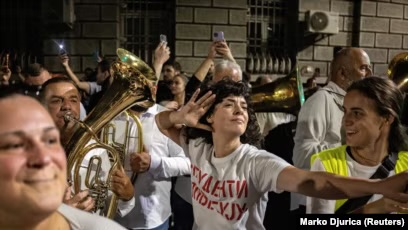 Will there be fair elections in Serbia next weekend?
 Kasparov: Talks with Putin are futile, war is the "ideological basis" of his power
 Zelensky: Russia aims to plunge Ukraine into complete darkness
 How the media landscape is changing in Serbia: Vučić's influence and the fight for media control