
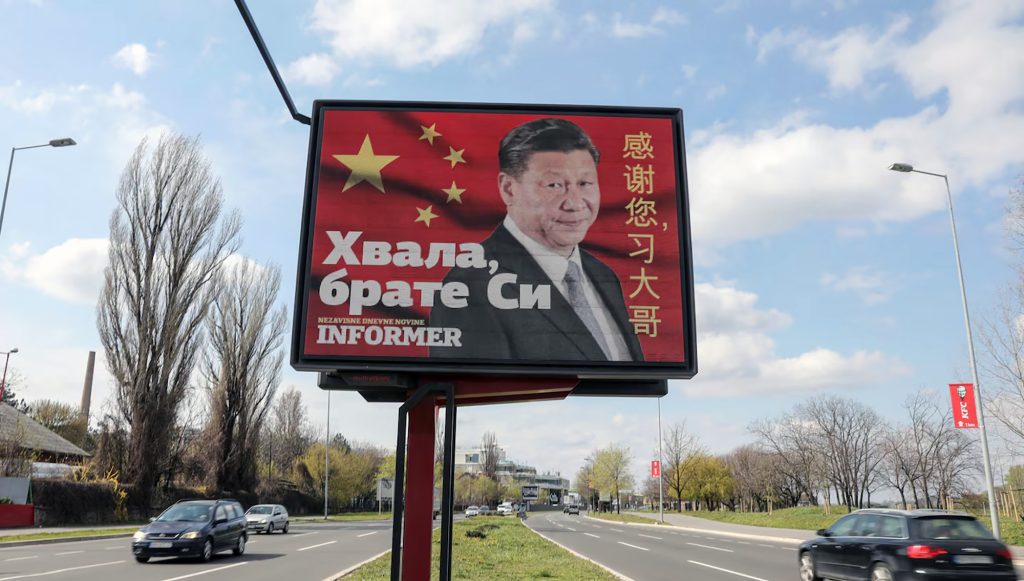
Serbian President Aleksandar Vučić announced a visit to China in mid-May. “In my professional life, this will certainly be the most important visit for the sake of the citizens of Serbia,” he declared.
Vučić's statement shows that, despite recent complications in China's relations with the European Union, China's foreign policy direction continues to remain a priority for Serbia.
However, partnership relations with Beijing are important not only for Belgrade, but also for Podgorica, Skopje, Banja Luka...
Against the backdrop of intensified efforts by the European Union to reduce Chinese influence, the importance of Beijing's presence in the Western Balkans is becoming a factor not only of regional economics and politics, but also of pan-European economics and politics.
Visualizing the impact
Chinese influence in the Western Balkans region has a strong visualization: highways, railways, bridges, energy facilities, large state contracts and the political obligations that inevitably arise around such projects. There are countries (Serbia) where interaction with China has gone even further, to security cooperation.
The European Union — which the Western Balkan countries aspire to join — remains the undisputed leader in grant aid: annual IPA grants averaged around 0.8% of the region’s GDP, while Chinese grants accounted for just 0.02%. But in lending, the picture is different: the EU annually provided loans amounting to around 1.5% of the region’s GDP, while China provided 1.2%. In Serbia, the Chinese loan portfolio has already surpassed the EU’s loan portfolio. Thus, in the area of loans and large contracting projects, the Chinese presence has proven to be much more tangible than is often imagined.
From the beginning, Beijing placed its bet on projects that the authorities could show voters as proof of “concrete results” and “development”: new highways, railway lines, bridges, modernization of transport corridors. Here lies China’s main political strength in the Western Balkans — in large infrastructure solutions that produce a visible quick effect, but which are often accompanied by opaque conditions, weak oversight, and significant long-term risks.
Kosova
Kosovo remains the country with the smallest Chinese presence in the region, not falling into the "trap" of Beijing's investments and influence, unlike some Western Balkan countries.
The institutions of the Republic of Kosovo have maintained a cautious approach towards Chinese companies and products, also taking restrictive and sanctioning measures in certain strategic sectors.
These decisions are seen as part of the country's Euro-Atlantic orientation and harmonization with the policies of Western partners.
Due to this approach, China's economic and technological influence in Kosovo remains significantly lower compared to other countries in the region.
Serbia
Chinese influence is most visible in Serbia, which has long been the main political and economic manifestation of China’s presence in the Western Balkans. The modernization of the Belgrade-Budapest railway corridor, new bridges, bypass roads, industrial and logistics projects involving Chinese state-owned companies have made Serbia the main regional platform for Beijing’s cooperation with the Balkans. But behind this spectacle, another story is becoming increasingly apparent – about the price of such a model. The disaster at the Novi Sad railway station in November 2024 after the collapse of a concrete canopy, which occurred after reconstruction works within the wider Serbian-Chinese-Hungarian railway project, turned the infrastructure issue into a full-fledged political crisis. A major transport project that was supposed to symbolize modernization suddenly became a symbol of the dangers of corruption, weak oversight and the dangerous fusion of state, business structures close to the authorities and political propaganda. Moreover, this very incident sparked large-scale anti-government protests and undermined the reputation of Serbian President Aleksandar Vučić.
Another case to draw attention to this issue was the news from Budapest: after Viktor Orbán’s party lost the elections, an audit of investments in the joint project with China to modernize the railway from Belgrade to Budapest is planned. At the same time, Serbia itself is continuing an investigation into possible corruption during the modernization of the section leading to the Hungarian border. The case involves 14 suspects, including two former ministers, while the budget losses are estimated at 115 million US dollars. According to the investigation, the Chinese consortium CRIC-CCCC may have been illegally provided with at least 18.7 million US dollars in benefits. However, the most painful negative consequence associated with this project was undoubtedly the tragedy at the Novi Sad railway station.
The story of the Belgrade-Budapest railway is important not only for Serbia and Hungary, but also for the entire region: it clearly shows how large Chinese infrastructure projects in the Western Balkans are increasingly becoming a source of political, financial and reputational risks.
The military aspect
It is also important that the Chinese presence in Serbia has long ceased to be limited to the economy in the narrow sense of the word. In recent years, Belgrade has been steadily purchasing Chinese weapons. In 2022, Serbia publicly demonstrated the FK-3 surface-to-air missile systems purchased from China, becoming the first European operator of this system. And in March 2026, Vučić confirmed the purchase of Chinese CM-400AKG air-launched missiles, which once again made Serbia a unique European user of Chinese precision-guided weapons. This is an important point: Serbian-Chinese ties in the Balkans are no longer limited to highways, railway stations or bridges, but are also entering the strategically sensitive military-technical sphere. It is for this reason that the Serbian case differs from the rest of the region not only in the degree of economic cooperation with Beijing, but also in the depth of political trust in it.
The new scandal surrounding the Belgrade-Budapest railway has only reinforced this trend. The fact that one of the most ambitious symbols of Chinese infrastructure in the region is increasingly associated not with modernization, but with inspections, suspicions, budget losses and questions about the contractual model is indicative. But even more indicative is that even against the backdrop of such scandals, Serbia is not showing any willingness to radically reduce its dependence on Chinese contractors. On the contrary, Chinese companies continue to take on large projects, while the cooperation model itself remains largely unchanged. This means that Chinese influence in Serbia should no longer be measured solely by the volume of new investments – what matters more is how deeply Chinese companies are already embedded in the state construction system and how firmly local elites have become accustomed to a format in which major infrastructure decisions are made under a regime of political exclusion rather than through a normal competitive procedure.
Montenegro
Montenegro offers a different, but no less telling, example. Here, the Chinese presence has long been associated primarily with the Bar-Boljare highway, the first section of which – Smokovac-Mateševo – opened in July 2022 and became one of the most famous stories in Europe about the dangers of a “debt trap”. It was precisely the Montenegrin highway that for a long time made the Western Balkans an example of how a large infrastructure ambition can turn into a source of debt and political vulnerability. But the story did not end there: in February 2026, Podgorica signed a contract with the Chinese consortium PowerChina–Stecol–PCCD for the construction of the upcoming Mateševo–Andrijevica section worth 693.9 million euros. It is about a section of approximately 23 km in length, financed not only from the budget, but also with the participation of a loan of 200 million euros from the EBRD and an EU grant of 150 million euros. This is an important signal, because even after all the warnings regarding the first section, the Chinese contractor still maintained a key position in a strategic project.
The Montenegrin case clearly illustrates the long cycle of Chinese influence. First, there is a large and politically favorable project that local authorities present as a historic breakthrough. Then questions arise about its cost, credit conditions, economic feasibility, environmental consequences, and the realizability of the promised benefits. Then, Western partners help to partially reduce the financial risks, but this does not necessarily mean a shift in the Chinese role. On the contrary, Chinese companies often remain the most important contractors for subsequent phases as well. As a result, China does not necessarily gain direct political control, but it gains a long-term presence in strategic sectors and, most importantly, the inertia of dependence on its contractors.
Northern Macedonia
North Macedonia shows another side of the problem. Here, the Chinese footprint is also largely infrastructural, but Chinese projects themselves are more often associated with corruption scandals, delays, and budget overruns after the project starts. The most famous example is the construction of the Kichevo-Ohrid highway with the participation of Sinohydro. The project was delayed for years, became more expensive, and became one of the most toxic symbols of how “quick fixes” in infrastructure can result in political and institutional failure.
The construction, which began in 2014, was plagued by serious design flaws: poorly designed roads, unstable slopes, tunnels that required redesign, and more than 80 modifications during the course of the works. This caused a significant increase in costs – from an initial 374 million euros to more than 600 million euros and later to 803 million euros, which the Parliament of North Macedonia officially approved in March 2026. The new completion deadline was extended to 31 May 2027.
The problems were not just technical. Sinohydro, which is implementing the project, was already on the World Bank’s list of companies excluded for corrupt practices when it was awarded the contract. This raised doubts about the terms of the deal, the quality of state oversight, and political patronage. As a result, the Kichevo-Ohrid highway became one of the clearest examples of how large Chinese infrastructure initiatives in the Balkans can create long-term financial, political, and institutional risks—even in countries where the scale of the Chinese presence is smaller than in Serbia or Montenegro.
In Bosnia and Herzegovina, the Chinese presence is not as concentrated as in Serbia or Montenegro, but the logic there is the same. In BiH, the Chinese footprint is particularly visible in large energy and infrastructure initiatives, which local elites often promote as a cost-effective alternative to slow and complex European mechanisms. And in Bosnia too, Chinese projects regularly become not stories of quick success, but rather ones of delays, disputes, and problematic economic feasibility.
A telling example is the project to build Unit 7 of the Tuzla Thermal Power Plant, which the Federation of BiH agreed in 2017 with the Chinese company China Gezhouba Group and financed by the Chinese Exim Bank: despite political promises of a “strategic breakthrough”, the project was blocked in legal disputes, EU criticism of state guarantees, delays and was effectively blocked after the Chinese contractor withdrew from contractual obligations in 2021. A similar dynamic is observed in Republika Srpska, where the construction of the Dabar Hydropower Plant, entrusted to China Energy Gezhouba Group, is progressing slowly due to permit delays, environmental disputes and a lack of transparency in procedures, which have been repeatedly acknowledged by both local authorities and European institutions. Another characteristic example is the Gacko 2 Thermal Power Plant project, which the government of Republika Srpska tried to implement together with China Machinery Engineering Corporation in 2017-2018: despite loud statements about investments exceeding 1 billion euros, the project never moved to the actual construction phase due to the lack of agreed financing, doubts about economic feasibility, and opposition to BiH's climate obligations.
This once again underscores the main point: Beijing is not offering the region a new, higher-quality development model, but is operating effectively in an environment where local governments need large, visible projects without overly stringent conditions regarding transparency, competition, and standards.
A challenge for the EU
In addition to infrastructure and military projects, Beijing is also building a softer version of its presence in the region – through education, language programs and academic exchanges. Confucius Institutes operate in Belgrade, Novi Sad and Niš; they offer language courses, prepare students for the HSK exams, offer scholarship opportunities and link the study of Chinese with broader educational and professional prospects. Similar platforms exist in other countries in the region: in particular, a Confucius Institute operates at the University of Montenegro and in Banja Luka – at the University of Banja Luka. This educational segment, of course, is not as influential as infrastructure contracts, but it helps Beijing create a more sustainable and socially acceptable presence in the region – especially where economic projects already provoke controversy.
The current moment is also important because China’s role in the region is entering a new phase. While in the 2010s the focus was mainly on expansion, grandiose promises and “future projects”, now the focus is increasingly on the legacy of agreements already made. In other words, China influences the Balkans not only through new investments, but also through the consequences of old ones: unfinished highways, more expensive railways, debt obligations, dependence on Chinese contractors and the political habit of local governments returning to the same partners even after scandals.
Chinese influence in the Western Balkans should neither be exaggerated nor underestimated. China has not become a full-fledged geopolitical hegemon in the region and is clearly incapable of competing with the EU as a political magnet or center of integration gravity. But this is not its goal either. Beijing’s strength in the region is more pragmatic. The Western Balkans can be seen by Beijing as a kind of fulcrum in Europe, from which it is convenient to extend its influence across the continent, above all in the EU countries. Moreover, the region’s already established economic, financial and infrastructural ties with China will become part of the EU’s internal market after future enlargements. Reducing Chinese influence in Europe is impossible without reducing it in the Western Balkans. For the European Union, this means that the policy of containing Chinese influence cannot be limited to the internal market: it must also include the pre-accession space, where the economic and institutional parameters of future enlargement are being shaped today. But in conditions where candidate countries (above all Serbia) are trying, on the contrary, to develop their relations with Beijing, Brussels' task is a complex and multi-layered challenge./CWBS
The GeoPost
 Suspicions of possible manipulation, European Parliament appoints observers for elections in Serbia
  Ukraine to resume attacks on Russian oil refineries, Zelensky says
  Wiretapping file: Vučić linked to drug boss, also gave guarantees for his release from prison
  Croatian MEP: No policy changes the historical fact that Kosovo, Croatia and Bosnia were victims of Serbian aggression
  Kallas: Russia will not force Ukraine to surrender, Europe will continue to support Kiev
  Lazar Radullović calls Serbian List a criminal organization: You can kill me, but you can't scare me