
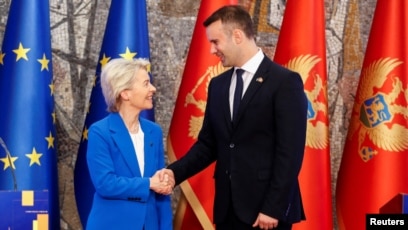
The topic of the program Most on Radio Free Europe was whether Montenegro could join the European Union in 2028. The guests were Daliborka Uljarević, director of the Center for Civic Education in Podgorica, and Zlatko Vujović, professor at the Faculty of Political Sciences.
The discussion included high praise from European Union officials for Montenegro’s progress on its European path, whether this will lead to Montenegro becoming a member of the European Union before all other candidates, why Brussels is so favorable towards Montenegro, and whether it forgives the ruling coalition for its mistakes and weaknesses.
They also discussed why, despite significant progress on the European path, citizens’ trust in the European Union is declining, what role the pro-Serbian media plays in this, who in the ruling coalition is not interested in Montenegro becoming a member of the European Union in the near future, how much recent nationalist incidents are damaging Montenegro’s European image, why it is not in Serbia’s interest for Montenegro to join the European Union before it does, whether Aleksandar Vučić could slow down Montenegro’s progress on the European path through his allies in Montenegro, and how Russia openly opposes Montenegro’s membership in the European Union.
Karabeg: Recently, Brussels has been praising Montenegro’s progress on its path to European Union membership. It is considered to have made the most progress of all the candidate countries and to have the best chance of becoming a member of the European Union before any of the others. Are you surprised by so much praise?
Uljarević: It’s not surprising, as the EU accession process has become primarily political. Such messages are mainly an incentive for Montenegro, and at a time when the European Union is facing numerous geopolitical challenges, it really needs a candidate success story. The European Union wants to revive its enlargement policy in the Western Balkans and thus counter the influence of Russia, China, and even Turkey. However, it is important not to confuse praise with assurances. Although Montenegro has made great progress in formal and technical terms, key reform initiatives are far from complete. If Montenegro is now top of the class of poor students, this does not mean that it is truly ready for membership of the European Union.
Vujović: I think the statements by European Union officials are entirely to be expected. Brussels wants to encourage Montenegro to join the European Union because, given its size and geostrategic importance in the Western Balkans, it is an ideal choice for a new member. However, praise, encouragement, and incentives are one thing, but how things will unfold after the conclusion of negotiations is another. Then comes ratification, when member states decide in their parliaments and possibly in referendums whether to support Montenegro’s membership in the European Union.
German optimism
Karabeg: Germany seems to be the most optimistic. Its Foreign Minister Johan Vadeful recently stated in Podgorica that there are real possibilities for Montenegro to become a member of the European Union by 2028.
Uljarević: There was a lot of optimism in the German foreign minister’s statement, but I am not sure that 2028 is a realistic deadline, nor that it is a year to which the European Union is committed. I would like to remind you that Kaja Kallas, the European Union’s High Representative for Foreign Affairs and Security Policy, recently said that 2030 is a much more realistic deadline. I think we should understand the praise more as friendly pressure to speed up reforms, especially when it comes to the rule of law, but I am not sure that the ruling coalition in Montenegro understands this properly.
Karabeg: While the German minister is extremely optimistic about the admission of candidates, Marta Kos, the Commissioner for Enlargement, talks about a probationary period for candidates before they join the European Union. Does this also apply to Montenegro?
Vujović: I don’t believe this applies to Montenegro, because Montenegro has a clear pro-European majority in public opinion, in parliament, and among members of the ruling coalition and the opposition. Montenegro is a pro-European country, unlike Serbia, where there is no real pro-European majority either in the public or in parliament. Countries where Russian influence prevails, such as Serbia, as well as some countries such as Moldova, which could easily slip into the sphere of Russian influence, as happened with Georgia, represent a risky choice for the European Union. Therefore, I believe that talk of a trial period refers to these countries, not Montenegro. However, this does not mean that Montenegro will avoid such a scenario if the negotiation process is not completed by the end of 2006 or mid-2027. There are many opponents of the plan for Montenegro to become a member of the European Union in 2028. Some are in Montenegro, some are in the region, and some are at the global level. When it comes to the region, Tirana is seeking to slow down the negotiations between Montenegro and the European Union, while Belgrade is seeking to halt them completely. On the other hand, Montenegro is governed by a coalition that is unable to respond to the political challenges and games being played both around and within Montenegro.
Decline in trust
Karabeg: Why is public trust in the European Union declining despite Montenegro’s progress on its European path? It is still high, but not as high as before. In six months, it has fallen by 14 percent—from 83 to 69 percent. Why such a sudden drop?
Uljarević: We have media outlets that directly or indirectly promote a pro-Russian narrative and spread disinformation, which erodes trust in the European Union. On the other hand, officials often shift responsibility to the European Union when they have to make certain unpopular decisions. We now have protests by locals against the construction of a collector in Botun, and officials justify this decision by saying that we have to do it for the European Union, instead of presenting arguments about the benefits of this project. Ultimately, citizens see a discrepancy between the praise coming from the European Union to Montenegrin institutions and their poor experiences with these institutions. When we see who the leading Europeans in power are today, it is difficult to shake the impression that the European path is a farce for them.
Vujović: I think the figure that more than 80 percent of citizens supported the European Union is unrealistic. In Montenegro, there is a traditional division between pro-Western and pro-Serbian or pro-Russian voters, who are predominantly anti-European. During the change of government in 2020, pro-Serbian citizens viewed the European Union with sympathy, as they saw it as an ally in consolidating the power of pro-Serbian and pro-Russian parties in Montenegro. However, as Montenegro began to move closer to the European Union, an anti-European campaign began, which was initially quiet but became louder as Montenegro’s chances of accession increased. This has already happened in Serbia. In Serbia, the majority of citizens were previously in favor of the European Union, but now only a third of voters support Serbia’s membership in the European Union. This is due to a constant disinformation campaign by the media, which is controlled by President Vučić. You now have a similar situation in Montenegro, where an anti-European campaign is being waged in the part of the media controlled by Serbian companies.
Access to the sea
Karabeg: Can Serbian President Aleksandar Vučić slow down Montenegro’s progress towards the European Union through his allies in Montenegro? Vučić, who has now turned more strongly towards the European Union and who constantly says that Serbia is the most prepared to join the European Union, would certainly be upset if Montenegro joined before Serbia.
Uljarević: Vučić is constantly trying to do this and has a strong influence within the Montenegrin government. Andrija Mandić, President of the Montenegrin Assembly, has been blocking the election of two members of the Council of the Agency for Audiovisual Media Services for almost a year, creating conditions for the European Union to reopen the temporarily closed Chapter 10 on the information society and media if it takes a closer look at the situation in Montenegro. Vučić has significant influence in the Montenegrin media, and his strongest lever is the Serbian Orthodox Church, through which he is now, I would say, attempting to assert ideologically based historical revisionism in an almost militaristic manner. Vučić has never really treated Montenegro as a truly equal and sovereign state, but rather as a temporarily lost Serbian territory. And that is why he cannot imagine Montenegro progressing faster than Serbia on the path to the European Union, as this would undermine his thesis that Serbia is leading European integration and that Montenegro is incapable of acting independently and effectively without Serbia’s influence and mentorship.
Vujović: It is very difficult to gauge how much power Vučić currently wields in Montenegro. I think it is sufficient to force his Montenegrin allies, namely the pro-Serbian parties led by Andrija Mandić, Milan Knežević, and, to some extent, Aleksa Bečić, to take steps that will provoke Croatia or the European Union to halt Montenegro’s accession process. If he fails to do so and Montenegro becomes a member of the European Union, it would be Vučić’s biggest defeat since he came to power in Serbia. Montenegro’s entry into the European Union would be a catalyst for change in the region and in Serbia itself. Vučić’s thesis that the European Union will never allow expansion into the Western Balkans would be shattered. By joining the European Union, Montenegro would become part of the Western world and Western democracy. And that would mean the end of Belgrade and Moscow’s dreams of Montenegro becoming their prey.
Because there is no effective military alliance between Serbia and Russia if Serbia does not have access to the sea or if Russia does not have communication with Serbia across the sea, and this can only be achieved if Belgrade and Moscow have control over Montenegro. This story is not over yet. After all, even Vučić himself sometimes makes statements confirming that he is still striving to bring Montenegro back into Serbia’s embrace. Montenegro’s membership in the European Union shatters the dream of Serbian-Russian domination over the Western Balkans.
Imported incidents
Karabeg: To what extent are nationalist incidents, such as the recent anti-Turkish demonstrations and attacks on Croatian fans, an obstacle to Montenegro’s path to the European Union?
Uljarević: The damage is significant because every nationalist incident sends a signal that our society is still deeply polarized, politically unstable, susceptible to manipulation, and vulnerable to external influences, as I truly believe that a significant part of this was triggered from outside, more specifically from Serbia. Those behind these incidents are clearly trying to undermine Montenegro’s credibility in the final phase of negotiations with the European Union, which, among other things, assesses the candidate’s resilience to extremism and hate speech. Each such incident is not only an attack on Montenegro’s social cohesion, but also affects the assessment of our readiness for the European Union. The attack on Croatian fans further worsens relations between Montenegro and Croatia and may contribute to the negative attitude of their citizens towards our accession to the European Union. On the other hand, everything that happened to the Turkish citizens is the result of strong manipulation, and this is not the face of Montenegro that I can accept.
Vujović: As far as the anti-Turkish protests are concerned, this was Serbia’s response to the delivery of Turkish military drones to Kosovo. Vučić wanted to show that he could undermine Turkish interests in the region, and the Western Balkans are very important to Turkey. Incidentally, these were not spontaneous protests. Who were the participants? Organized groups of Serbian club fans, loyalists of the official Belgrade, and officials of ultra-Serbian parties that are part of the ruling coalition in Montenegro. The Serbian intelligence service was behind it all. Based on false information received from the Police Administration and the Ministry of Internal Affairs, the government reacted hastily and abolished the visa-free regime for Turkish citizens. I believe that this decision will soon be revoked.
The Metropolitan’s ‘sacred cow’
Karabeg: What is the Serbian Orthodox Church’s attitude towards Montenegro’s European path?
Uljarević: Its position depends on the attitude of official Belgrade towards the European Union. The Serbian Orthodox Church is essentially alien to European values based on secularism, pluralism, respect for human rights, especially those of marginalized groups, and the civic model of the state. The highest representatives of the Serbian Orthodox Church in Montenegro have often been critical of the European Union. And even when they have to accept it for publicity reasons, they accept it as a kind of unpleasant inevitability. This is best illustrated by the recent statement by Metropolitan Joaniki of Cetinje-Primorska that he is in favor of Montenegro’s accession to the European Union, but that it is not a “sacred cow” that everyone should worship. Vujović: The Serbian Orthodox Church has a declaratively positive attitude towards Montenegro’s entry into the European Union, but in reality it is very negative. This negative attitude is evident on the ground, where dignitaries of the Serbian Orthodox Church are leading an anti-European and anti-Western campaign. The Serbian Orthodox Church essentially represents the interests of Russia and the Russian Orthodox Church in this region. One could say that the Serbian Orthodox Church is Russia’s most important source in the Western Balkans because it completely follows Moscow’s demands.
Karabeg: Russia is clearly dissatisfied with Montenegro’s rapid rapprochement with the European Union and is communicating this openly and undiplomatically. Its ambassador to Montenegro, Aleksandar Lukasik, recently said that Montenegro’s commitment to NATO and the acceleration of preparations for entry into the European Union is a short-sighted policy that is not in the interests of Montenegrin citizens. Do you see this as a threat?
Uljarević: Russia operates in Montenegro much more indirectly than directly, mainly by spreading disinformation, supporting pro-Russian political and social actors, and using church infrastructure. This influence is not always visible, but it is very well thought out. Such open statements, such as the recent statement by the Russian ambassador, are rare. I think it is very good that the Ministry of Foreign Affairs invited the Russian ambassador for talks and made it clear to him that his behavior is unacceptable. However, it should be noted that this is not the unanimous position of the entire government, which further complicates efforts to limit Russia’s malign influence.
Vujović: Russia sees the European Union as a key enemy with which it is fighting for dominance over the countries of the former Warsaw Pact, and not only the Warsaw Pact, but also the Soviet Union. The European Union is the best guarantor of stability for countries that were once communist, and the biggest obstacle to the spread of Russian influence in these countries. As for Montenegro, Russia did not expect its rapid progress towards the European Union, and the closer Montenegro gets to membership, the more nervous Russia becomes and tries to destabilise it.
Serbian-Russian scenario
Karabeg: Does Moscow have the ability to hinder Montenegro on its path to Europe?
Uljarević: Yes, there is. We saw this in 2016 in the case of the failed coup, when it became clear to Russia that it could not prevent Montenegro from joining NATO, but it did everything it could through its allies in Montenegro to slow down the process. However, its actions had the opposite effect, as NATO member states realized that they had to accept Montenegro as soon as possible in order to prevent Russia from strengthening its influence. I believe that this attitude towards Montenegro still exists today in the European Union, despite the caution of the Baltic states, which fear that one of the countries with strong Russian influence could join the European Union, thereby giving the Union a Russian Trojan horse. I also think that Marte Kos’s statement about a trial period reflects such fears, but I don’t think this applies to Montenegro.
Vujović: I believe that Russia has the capacity and resources in Montenegro to slow down our movement towards the European Union. These resources are members of the ruling coalition who will always show greater loyalty to Moscow than to the values championed by the European Union. If it were up to them, Montenegro would definitely halt negotiations. However, Russia and its allies are not the only ones operating in Montenegro. The European Union, Western allies, and pro-European forces in Montenegro are taking steps to counter Russian influence and raise the cost of Russia’s support for pro-Russian actors in Montenegro so high that they will refrain from or abandon actions that benefit Russia. I therefore believe that Montenegro will succeed in extricating itself from the scenario being prepared by Belgrade and Moscow and that it will become a member of the European Union, although it is questionable how realistic it is for this to happen in 2028. It is possible, but I do not know how willing the ruling coalition is to give up its interests and take measures to accelerate Montenegro’s accession to the European Union./RSE/
 Serb suspect of attack on KFOR in Zvecan, at the center of affair in Serbia
  Violence on election day in Serbia: Suspicions that vucic is signaling the message that he will not leave power peacefully
  Chinas factory activity shrinks again in November, services cool
  Sarajevo sniper killings: Journalist says Vučić was the organizer
  Ukraine hits two Russian ‘shadow fleet’ oil tankers with naval drones
  South Africa arrests four men suspected of planning to fight for Russia