
In the last two years, the political scene of Bosnia and Herzegovina was characterized by political blockades and obstacles.
During this period, the country did not make any significant progress towards either the European Union or NATO.
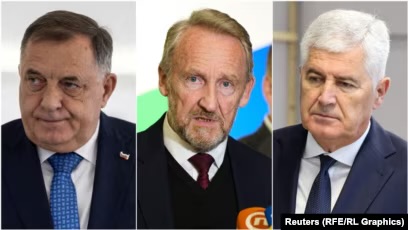
Now, after the elections, the possibility has reopened for the League of Independent Social Democrats (SNSD), the Croatian Democratic Union of Bosnia and Herzegovina (HDZ BiH), and the Party of Democratic Action (SDA) to form government at the state level – parties that, in various coalitions, had been part of the government and political agreements in this country for years.
But can we talk about a new beginning on the path of European and Euro-Atlantic integration?
The SNSD, led by Milorad Dodik, who has pro-Russian views, openly opposes Bosnia and Herzegovina's membership in NATO.
In recent statements, Dodik also spoke out strongly against the European Union, under his current leadership.
Bosnia and Herzegovina's HDZ officially supports the path towards European integration.
The SDA, although in opposition at the state level last term, during previous terms in power had failed to resolve a number of problems that have been hindering the country's European integration for years.
None of the three parties responded to Radio Free Europe's questions about what positions they will take during the negotiations for the formation of a government regarding European integration, NATO membership, and relations with Russia.
What do the EU and NATO say?
Bosnia and Herzegovina received the status of candidate country for EU membership in December 2022 and the green light to open negotiations, but a large part of the work remains unfinished.
Justice reforms, the fight against corruption, the functioning of institutions, state property, the issue of the Constitutional Court, and a number of other disputes continue to await political agreements.
In addition, European institutions constantly warn about malign Russian influence, emphasizing that "full alignment" with the European Union's common foreign and security policy is expected from Bosnia and Herzegovina.
This also includes the stance towards Russia after its invasion of Ukraine.
The European Parliament, in its latest assessments, welcomed Bosnia and Herzegovina's formal alignment with sanctions against Russia, but at the same time warned that blockades and political divisions continue to slow down the reform process and the country's European path.
The European Commission warned earlier that Bosnia and Herzegovina's authorities had not implemented any of the 113 reform measures they had pledged to.
As a result, this country did not benefit from the first tranches of European financial assistance.
European High Representative for Foreign Affairs and Security Policy Kaja Kallas and Enlargement Commissioner Marta Kos called on political actors on October 6 to form government "without delay" at all levels and build consensus so that Bosnia and Herzegovina can progress towards membership in the European Union.
They emphasized that the EU will continue to support the European integration of Bosnia and Herzegovina as a single, sovereign state with territorial integrity, while they expect the new authorities to continue implementing reforms and utilizing the opportunities offered by the EU's Growth Plan for the Western Balkans.
NATO headquarters told REL that the Alliance expects the formation of institutions and continued cooperation with Bosnia and Herzegovina.
NATO stressed that it remains strongly committed to the country's sovereignty and territorial integrity.
Asked by Radio Free Europe to what extent the close ties that some of the election winners in Bosnia and Herzegovina maintain with Russia could affect the country's relations with NATO, the Alliance responded that "a stable and secure Bosnia and Herzegovina, as well as a peaceful Western Balkans, are in our strategic interest."
"NATO supports the European Union's Operation Althea, which is being conducted within the framework of the Berlin Plus agreement, and we will not allow the creation of a security vacuum in Bosnia and Herzegovina. Threats of secession, internal political clashes, regressive and nationalist ideas are destabilizing and dangerous," NATO's response to the REL states.
NATO also recalled that it has been cooperating with Bosnia and Herzegovina for more than three decades and that it continues to support reform processes, strengthening the sustainability of institutions and developing the capacities of the Armed Forces of Bosnia and Herzegovina.
Dodik between Moscow and Washington
Given the positions of the EU and NATO, Russian influence, according to REL's interlocutors, could be one of the main issues during the further process of forming power at the state level in Bosnia and Herzegovina.
SNSD leader Milorad Dodik has developed close political relations with Russian President Vladimir Putin in recent years, while representatives of Republika Srpska refused to support the imposition of sanctions against Russia following its invasion of Ukraine.
A few days before the elections, Dodik visited Moscow again, where he was received by the Russian president.
Meanwhile, on election night, he thanked both Putin and US President Donald Trump.
Vedran Đihić, lecturer at the Faculty of Political Science in Vienna, believes that the Russian dimension of Dodik's politics remains unchanged.
"What remains constant and cannot change is the pro-Russian dimension. Dodik cannot give up his pro-Russian stance. This political line has brought him political benefits and remains one of the foundations of his political positioning," Đihić tells REL.
Dzihic adds that, on the other hand, the SDA has a clear position, according to which Russia is the aggressor in Ukraine, while Russian influence in the region is negative.
"The question remains what stance the HDZ of Bosnia and Herzegovina will take towards Russia and how much it will manage to maintain the balance between European policy and partnership with the SNSD. Its stance will also depend to a large extent on that of Croatia, which has joined the European Union's policy on sanctions against Russia," says Đihić.
Political analyst Mladen Bubonjic estimates that developments outside Bosnia and Herzegovina – from the war in Ukraine to relations between the European Union, Russia and the United States – will have a significant impact on political processes in the country.
According to him, future relations between Dodik and Moscow will also depend on these developments.
He emphasizes that the SNSD leader calculates his actions in accordance with political interests.
"It suits Russia that there is a political obstacle in this region, which slows down European and Euro-Atlantic integration. In this context, the interests of Moscow and Dodik coincide," says Bubonjic.
Dzihić, on the other hand, emphasizes that Dodik has also benefited politically from the change in circumstances in relations with the United States, after the end of last year saw the lifting of American sanctions imposed on him due to obstruction of the implementation of the Dayton Agreement, corrupt activities, and the undermining of Bosnia and Herzegovina's institutions.
After Trump returned to the White House, the sanctions were lifted, while Dodik, during the election campaign, presented this as evidence of Washington's change in attitude towards him and Republika Srpska.
The authorities of Republika Srpska spent, in recent years, several million euros on the engagement of lobbying and consulting companies in the United States, in an attempt to improve the political position of the entity and its leadership in American political circles.
No high expectations for progress towards the EU
Unlike the HDZ of Bosnia and Herzegovina and the SDA, which during the election campaign presented Euro-Atlantic integration as one of the priorities of the future government, the SNSD continued to hold significantly more critical positions towards the European Union.
Over the past few months, the party's leader, Milorad Dodik, has repeatedly criticized the current EU leadership and opposed several demands from Brussels that envision new powers for state institutions.
At the same time, the SNSD continued to support cooperation with the European Union, but opposed Bosnia and Herzegovina's membership in NATO and rejected some of the EU's policies towards Russia.
For Đihić, the election result does not bring much uncertainty regarding the further progress of European integration.
"I do not see, at least in the coming period, any particular possibility for this process to get out of hand. Compromises between these three national parties, in the possible new composition of the Council of Ministers, are not natural, at least when it comes to European integration and strengthening the functionality of the state," emphasizes Đihiq.
In 2019, the European Commission set out 14 priorities that Bosnia and Herzegovina must meet to progress towards membership.
They include justice reforms, the fight against corruption, the functioning of institutions, public administration, and the protection of human rights.
Đihić says that the SNSD and HDZ “support the further ethno-territorial division of Bosnia and Herzegovina and the weakening of the common state,” while the SDA and other pro-Bosniak political forces advocate for a more functional Bosnia and Herzegovina.
"The only question is whether there will be enough pragmatism to, through minimal steps and reforms, ensure that Bosnia and Herzegovina continues to benefit from funds from the Growth Plan and other European funds," says Đihić.
NATO membership remains a divisive issue
Bosnia and Herzegovina has been part of the Partnership for Peace program since 2006, while cooperation with NATO has continued in recent years through the Bosnia and Herzegovina Reform Program.
However, a political consensus on membership in the Alliance has never been reached.
Dodik's SNSD has insisted for years on the military neutrality of Republika Srpska, while Bosnia and Herzegovina's SDA and HDZ support rapprochement with NATO.
"In these circumstances, there can be no official and formal acceleration of the path towards NATO membership. But cooperation will not be completely interrupted either. It will continue more or less in the same way as before," says Dzihic.
The Director of the Center for Security Studies, Denis Hadzhovik, believes that, despite deep differences, there is room for agreement.
"In the end, the willingness of political actors to dialogue and reach compromises will play a decisive role. No matter how far-fetched political positions may seem today, power cannot be formed without an agreement between the parties that have gained legitimacy from the elections," says Hadzovic.
What did the previous term's government leave behind?
After the 2022 elections, the state-level government in Bosnia and Herzegovina was made up of the SNSD, the HDZ of Bosnia and Herzegovina, and the parties united around the "Troika" coalition.
Although during this period Bosnia and Herzegovina received the status of candidate country for membership in the European Union and approval to open accession negotiations, a number of key reforms were not adopted, slowing down the country's progress towards the EU.
During 2024, this country also had delays in approving the Reform Agenda, necessary to benefit from funds from the EU Growth Plan for the Western Balkans, within which around one billion euros have been earmarked for Bosnia and Herzegovina.
Political disputes focused on issues of the Constitutional Court of Bosnia and Herzegovina, state property, and the competencies of state institutions.
The authorities of Republika Srpska opposed the appointment of new judges and the presence of foreign judges on the Constitutional Court.
The mandate was also characterized by clashes regarding secessionist decisions by the authorities of Republika Srpska, which challenged the decisions of the Constitutional Court of Bosnia and Herzegovina and the international High Representative.
And, SNSD leader Milorad Dodik, despite being dismissed from the post of president of Republika Srpska after a final court decision, retained his position as party leader and considerable political influence. /REL
 Kandic nominates Kamber for the post of Deputy Speaker of the Serbian Parliament
 Russian demands for NATO raise alarm in Central Asia and the Caucasus
 Student List aims to review agreements with Kosovo, EU says Serbia must implement them
 Natasha Kandic questions the credibility of the National Convention for the EU after the scandal of the nationalist melody against Kosovo
 What does Seselj know about the murder of Oliver Ivanovic in northern Kosovo?
 Serbian police do not clarify whether Radoićić crossed the border