
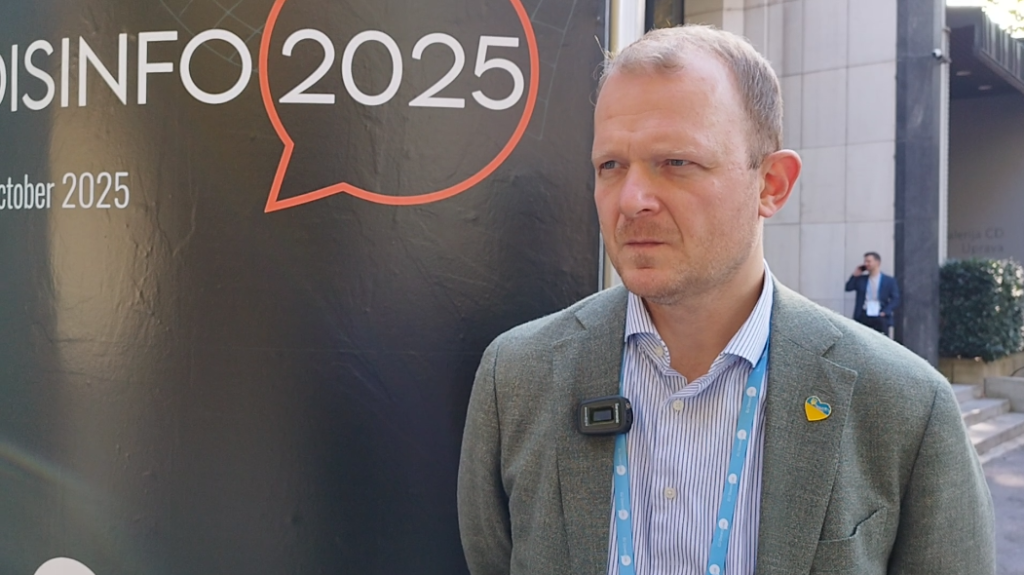
Photo: The Geopost
The war in Ukraine has shown that the information front is as important as the military one, says Jakub Kalenský, deputy director at the European Centre of Excellence for Countering Hybrid Threats (Hybrid CoE) in Helsinki.
In an interview with The Geopost, Kalenský emphasizes that Artificial Intelligence (AI) is the main innovation in how Russia spreads disinformation today.
Kalenský warns that bad actors like Russia are already using AI better and more often than democratic societies, which need to invest more resources and develop defensive mechanisms to avoid being defeated in this new information battle.
Full interview:
The Geopost: What are the main new narratives used by Russian disinformation campaigns to shape public opinion in Europe?
Kalenský: I think when it comes to narratives, Russia doesn't offer us much that's new. I think the narratives are mostly repetitive. It's about undermining support for Ukraine, it's about undermining the audience's trust in their institutions, it's about increasing the level of polarization in your country, making people angrier, more emotional. I think when it comes to content, it's still very much the same. Something we've seen since 2013-2014 when Russia renewed its information aggression. So I think the new things are more in the delivery of information, in the way the Russians deliver the content.
The Geopost: How is AI currently being used to support or disrupt disinformation campaigns?
Kalenský: This is exactly one of the elements that provides novelty in the Russian disinformation campaign. So it's not so much about the content, but more about the way they're trying to deliver the content. AI can help you produce mass content more easily. So whereas before it would have taken several people writing several versions of the same narrative, now you can just write one message and AI gives you hundreds of variations of the same message, which is very convenient when you're a disinformation aggressor and you're trying to run disinformation campaigns.
Another way it really helps is with better translations. So, disinformation campaigns of the past were sometimes revealed by poor use of the target language. The campaigns were revealed because the Russian trolls weren't particularly proficient in French or Finnish. Nowadays, new AI tools can now generate language that is almost indistinguishable from a native speaker.
So this is another way that AI makes it a lot easier. And finally, AI makes it easier to micro-target content. A lot of disinformation works because it's targeted to a very carefully selected audience. Before, you would need an army of sociologists who would have the right sociological data. Nowadays, AI can actually do this much, much better, much faster. So these are some of the ways that AI can help you with content distribution.
The Geopost: How can we protect ourselves from the growing threat of disinformation created by AI?
Kalenský: The reason bad actors are better at this is that they spend more resources on it. Not just money, but people. So one thing we need to do, and we should have done even before AI became a factor, is to significantly increase the amount of resources we spend on this. We can't let the situation be where Russia outnumbers us in the information space 1,000 to 1.
This is a problem. And they don't even need to be smart. They just beat us with numbers. So this is something where we need to take a step forward. But also, AI can definitely help you not only generate these information campaigns, but also detect them. And there are some startups here that are already doing some pretty interesting work. I would highlight maybe the Ukrainian Let's Data because they have front-line experience. They know what they're doing. But again, the problem is that bad actors are using these tools better or more often with more resources than we are.
So, we need to take a step forward. That's the main message.
/The Geopost
 Fivenson: The Balkans must strengthen the fight against disinformation
  Klodiana Kapo on The Geotalks: Russian propaganda in Albania spreads mainly through Serbia
  Espionage, propaganda and disinformation: How is Serbia's hybrid war against Kosovo unfolding? Security expert Drizan Shala speaks
  Vrajolli: Serbian nationalist statements are no coincidence, the "Serbian world" aims for influence in the region - a strong strategy is needed in the face of hybrid war
  Alban Zeneli on TheGeotalks: Information Manipulation and “Fake News”
  Sylë Ukshini: International recognition of Kosovo has buried the idea of Greater Serbia