
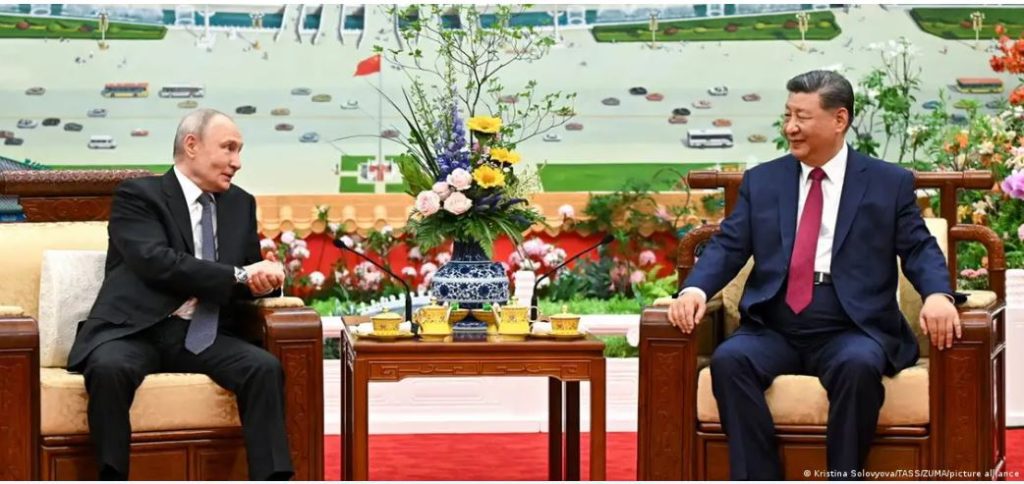
Russia can celebrate its “borderless” partnership with China — a phrase coined when President Vladimir Putin and Xi Jinping met shortly before the war in Ukraine. Many Russian-Chinese analysts believe that Beijing’s influence over Moscow is likely to grow further in the coming years.
Putin is interested in pushing forward projects for the construction of new pipelines that will further boost Russia's export revenues to China.
Increasing Russian pipeline capacity to China “would significantly increase Beijing’s oil security in the event of a Taiwan contingency,” Joseph Webster, a senior fellow at the Atlantic Council, wrote in a post on Substack on Sunday.
Webster was referring to China's repeated threats to invade Taiwan, a move that could bring Western sanctions on Beijing or even a US naval blockade disrupting oil imports from the China Sea.
The Kremlin is particularly interested in finalizing construction of the Power of Siberia 2 gas pipeline, which could transport up to 50 billion cubic meters of gas per year to China via Mongolia. The project remains stalled due to disagreements over pricing and technical details.
Beijing's desire for reliable land-based energy supplies has grown after disruptions in the Strait of Hormuz during the war with Iran. But any progress on these plans would further tie Russia's energy future to China, reinforcing Beijing's influence over Moscow.
Although bilateral trade softened last year as a result of lower oil prices, Russia's goods exports to China have almost doubled since February 2022, when the Russian attack on Ukraine began.
Balances between countries
In 2024, Russia shipped goods worth approximately $129 billion (111 billion euros) to China – the vast majority in crude oil, coal and natural gas sold at deep discounts.
The Center for Research on Energy and Clean Air calculated that China has purchased more than 319 billion euros ($372 billion) of Russian fossil fuels since the start of the conflict, giving Moscow significant financial means to finance its military amid Western sanctions.
In return, China has exported nearly $116 billion worth of goods to Russia, supplying machinery, electronics, and vehicles that replaced Western suppliers that withdrew from the Russian market.
Although Beijing has not directly exported military equipment to Russia, China has supplied Russia with civilian products and technologies that also have military applications. These have also helped support Russia's defense industry. This growing imbalance leaves Moscow increasingly vulnerable to Beijing's priorities.
Why is Russia increasingly dependent on Chinese technology?
Western sanctions, imposed since 2022 and constantly tightened, have cut off Russia's access to advanced Western technology.
The United States, the European Union, the United Kingdom, and allies banned exports of semiconductors, microelectronics, precision machine tools, and other dual-use goods for weapons production. These moves created acute shortages in Russia.
In response, Moscow turned to China, which, according to Bloomberg, will supply roughly 90% of Russia’s imports of sanctioned technology by 2025 — up from 80% last year. Getting goods like machinery to assemble missiles and drones is much more difficult and expensive than before the war. Russia has to use complex networks through third countries and often ends up paying for products at nearly 90% above pre-war prices. Bloomberg reported last year that Beijing has provided Russia with intelligence for Earth observation, military-grade satellite imagery, and drones. Chinese technology has enabled Russia to sustain and even expand production of missiles, drones, and other weapons, keeping the war economy running.
Trading in Chinese currency
As the war in Ukraine continues, America, the EU and allies have excluded major Russian banks from the SWIFT payments system and frozen approximately $300 billion of Russia's central bank reserves held abroad.
This has made dollar or euro transactions risky or impossible for Russia. The move also exposed foreign banks, individuals, and entities around the world to secondary sanctions if they continue to do business with sanctioned Russian entities.
In response, Moscow and Beijing accelerated so-called de-dollarization, the shift away from the use of the US dollar towards their national currencies. According to Russian Finance Minister Anton Siluanov, by the end of last year, the two countries were conducting over 99% of their bilateral trade in rubles and yuan.
This trend has been reinforced by the BRICS group of emerging economies, which is promoting local currency payments among its nearly a dozen members. There are even plans for a single BRICS currency.
However, yuanization, as it is called, has created new dependencies. Russia now faces periodic yuan shortages, higher borrowing costs, and must tolerate Beijing's dominance in all bilateral negotiations.
China is not trying to replace the dollar overnight, but a more widely used yuan increases Beijing's global economic influence. Countries that hold or borrow in yuan become more tied to China's economy and politics.
The GeoPost
 F16 on alert in Romania after drone incident: NATO reacts harshly to Russia
  "Political agreement", Hungary and the EU towards unlocking over 16 billion euros
  Japan sends troops to train with NATO mission in Ukraine
 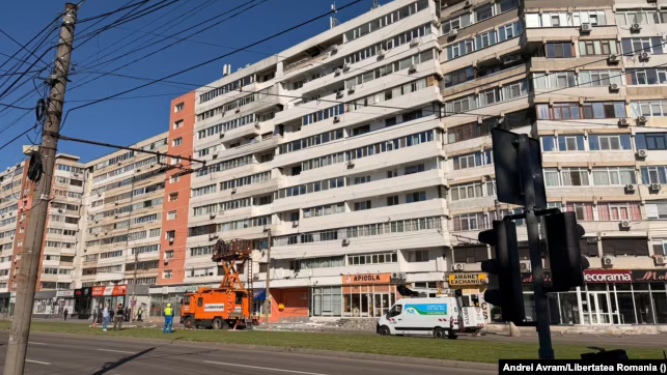 Europe and NATO warn Moscow after Russian drone hits residential building in Romania
  NATO moves to the Baltics – up to 60 troops near the border with Russia
  America's Invisible Shield – How Does NORAD Work Today?