
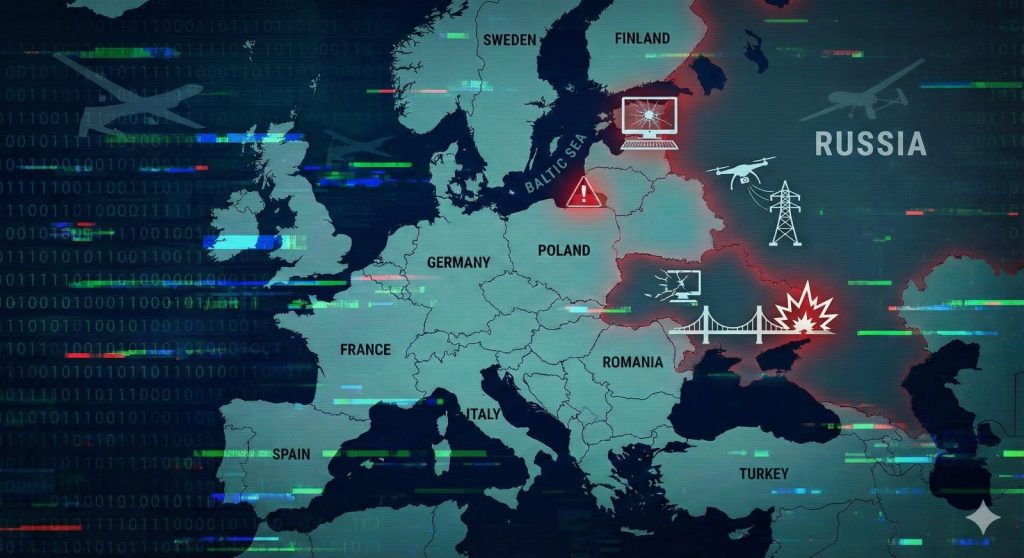
A bill to strengthen the security of NATO's northeastern flank has advanced in the United States House of Representatives, in a move aimed at increasing attention to the military, cyber and hybrid threats facing the Baltic states.
Last week, the House Foreign Affairs Committee approved the Baltic Security Assessment Act, a bill sponsored by Wesley Bell, by a vote of 41 to 3.
The bill requires the US Department of State, in coordination with the Department of Defense, to submit within 180 days a comprehensive report on threats to Estonia, Latvia, and Lithuania, as well as identify steps to strengthen defense cooperation between the US and the Baltic region.
In an interview with Radio Free Europe, Bell said the move sends a clear signal that the United States remains committed to its allies in the face of threats from Russia.
According to him, the Baltic region is key to NATO's collective defense and to curbing the ambitions of Russian President Vladimir Putin.
"We must stand by our allies who stand by us and continue to be reliable partners," Bell said.
He stressed that the bill does not only focus on traditional military threats, but also on cyberattacks, disinformation, GPS disruptions and hybrid tactics that, according to him, are being used by adversaries such as Russia and China.
Bell also warned of increased cooperation between Russia and Iran, saying these threats cannot be treated in isolation.
"We cannot fool ourselves by looking at these threats in isolation. Many of our adversaries are coordinating and cooperating," he declared.
He added that the outcome of the war in Ukraine will have a long-term impact on regional security and that support for Ukraine and the Baltic states remains broadly consensus in Congress.
According to Bell, the US message to allies on NATO's eastern borders is that Washington remains a reliable partner and committed to collective defense.
 Von der Leyen: Kremlin is imposing a digital iron curtain on Russians
  How Russia is using disinformation and cyberwarfare to destabilize Europe
  Italy extradites Chinese hacker accused of spying for Beijing to US
  Merz says Ukraine's path to EU is key to ending war with Russia
  Propaganda as a weapon of war: Research reveals the influence of Kremlin narratives on Russian soldiers
  From propaganda to invasion: How Russia aims for dominance in the region