
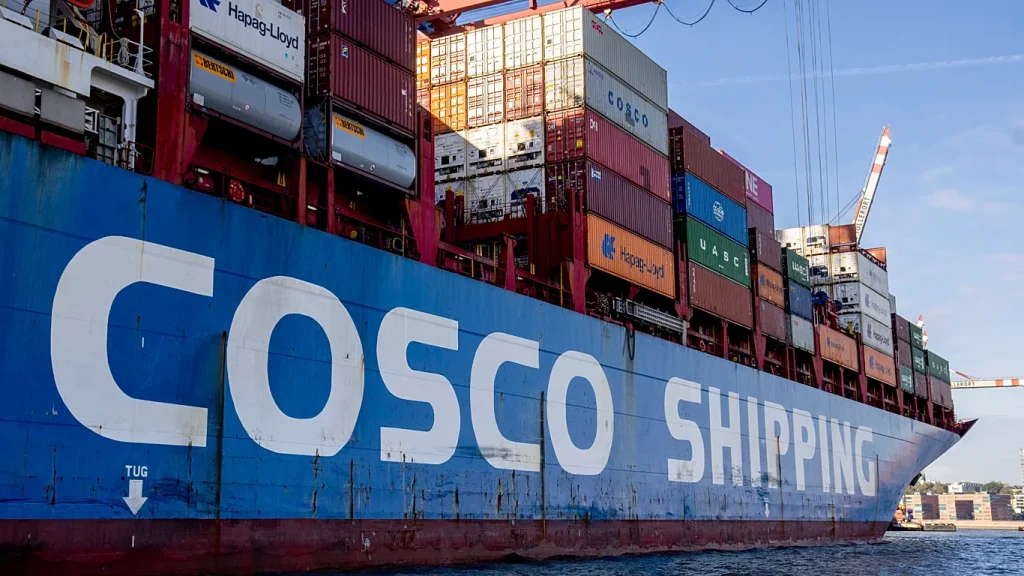
A draft document seen by Euronews shows that EU transport ministers are preparing guidelines for member states on how to assess foreign investment in EU ports and implement controls to counter China's influence.
The European Union is preparing new guidelines to combat China's increasingly worrying influence on the bloc's critical maritime infrastructure, according to a Council document seen by Euronews.
While the document does not explicitly mention China, references to foreign investment screening, ownership of critical infrastructure, geopolitical threats, and strategic autonomy leave little doubt about the underlying concern.
State-linked Chinese companies, such as COSCO Shipping, hold stakes in major EU ports, including the Ports of Hamburg and Rotterdam in Germany, and the Port of Piraeus in Greece is often called "Beijing's gateway to Europe."
The Council conclusions, proposed by the European Commission last December and expected to be adopted by transport ministers on Monday, reflect a profound shift in European thinking from treating ports simply as commercial gateways to seeing them as strategic assets supporting supply chains, energy security and military mobility.
The strategy under development "addresses competition with third countries and foreign ownership and strengthens logistical security," the Commission proposal states.
EU transport ministers will support statements “aimed at avoiding excessive foreign ownership or control of critical port infrastructures and operations, including the risks associated with organised crime infiltration, in particular those related to military mobility and the economic security of the Union”, according to the Council document.
China's influence
For more than a decade, state-linked Chinese companies have been expanding their presence across European maritime networks, buying stakes in terminals and logistics assets from the Mediterranean to Northern Europe. What once seemed like a matter of investment and trade is now increasingly seen as a security issue.
The Port of Hamburg agreement was supported by former German Chancellor Olaf Scholz between 2021 and 2022, arguing that it would strengthen Germany's trade position and maintain the city's competitiveness as a major European port.
But some German government figures warned at the time that Chinese ownership of critical infrastructure could create economic and political dependencies similar to the country's previous reliance on Russian energy, which left it badly exposed to price shocks when Russia invaded Ukraine in 2022.
German MEP Jens Gieseke, spokesperson for the European Parliament's transport and tourism committee on behalf of the European People's Party (EPP), welcomed the Commission's new proposal.
“China today owns stakes in more than twenty European ports – including the Port of Hamburg and the Port of Rotterdam,” he said. “The Port of Piraeus is fully controlled by Chinese operators. This level of exposure to critical infrastructure cannot be ignored.”
EU leaders now seem concerned that ownership of ports could translate into strategic influence over infrastructure, which has become increasingly important for both economic and military purposes.
At the heart of the Council document is a call for stricter control of foreign investment in ports, in particular “the aim of providing guidance on the assessment of foreign investment” in EU ports, as well as “the enforcement of controls”.
However, transport ministers are careful not to disrupt the “investment environment for European ports” and to “avoid discouraging credible investors”.
The geopolitical backdrop is hard to ignore. Russia's full-scale invasion of Ukraine, the conflict in the Middle East, and growing concerns about economic austerity have prompted European governments to reassess vulnerabilities in critical infrastructure. Ports, which handle nearly three-quarters of the EU's external trade, are at the heart of these concerns.
The Mercator Institute for China Studies (MERICS) has warned that the problem with the Port of Piraeus is not the Chinese concession rights themselves, which, according to the research organization, “would be irrelevant in a state of war,” but the commercial port infrastructure provided by the Chinese, which could be used for intelligence gathering.
Expanding monitoring beyond EU ports
The Council's draft conclusions also signal concern about foreign influence beyond the EU's borders.
Member states are calling for closer monitoring of investments in ports located in neighbouring third countries, warning that developments outside the EU could affect the competitiveness, security and sustainability of European supply chains.
This reflects the growing awareness that the impact on maritime routes does not stop at the EU's external border.
A port developed, financed or controlled by strategic competitors in North Africa, the Balkans or the Eastern Mediterranean could change trade patterns and potentially reduce the importance of nearby EU facilities, the document warns.
The GeoPost
 "They don't want war" - Russia's military recruitment rate drops to lowest level
  NATO allies consider accelerating drone purchases amid growing aerial threats
  EU considers sanctions against Russian patriarch, chess federation head, others
  After victory in parliamentary elections, Armenian Prime Minister mocks Putin
  Finland, Norway, Latvia and Germany increase support for Ukraine, Zelensky calls for strengthening air defense
  "Iran-like scenario", why is there growing fear for Putin's safety?