
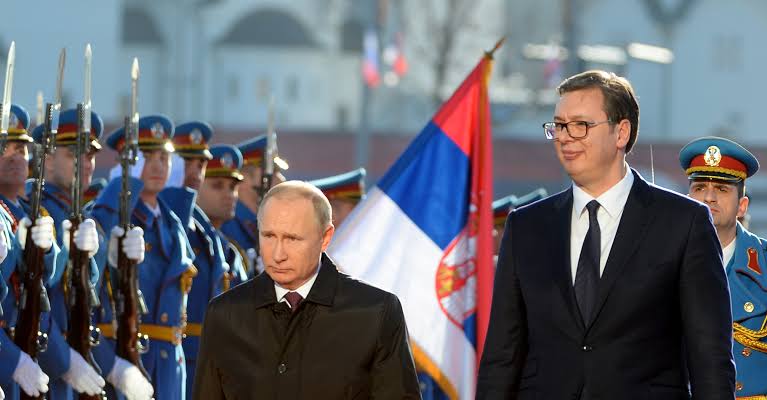
With accusations of the blessing of the Russian Patriarch and the support of a senior State Duma official, another Russian minority party has been established in Serbia.
Eleventh in line – although the Russian minority community is only the 16th largest in Serbia and has just over 10,000 members.
The representative of the newly founded Party of Russian-Serbian Unity (SRSJ) is Rade Savić from Smederevo.
The party's website states that its goal is to advocate for building a prosperous Serbia, abandon its candidacy for membership in the European Union, and "strengthen the alliance" with "Russian brothers."
However, there is no mention of the position of the Russian national minority in Serbia.
"If experience is any teacher, they most likely have no connection to Russia, nor to the Russian community in Serbia," Vuk Vuksanovic, a lecturer in foreign policy and grand strategy at the Department of War Studies at King's College London, told Radio Free Europe.
The Russo-Serbian Unity Party was registered a few days before the elections were announced and immediately began collecting signatures for a list of candidates.
They did not respond to Radio Free Europe's questions about their minority status, their participation in the elections, and any possible ties to Russia.
Vuksanović believes that in this case, there is a tendency to “abuse the fact that a party, to be characterized as a minority party, does not necessarily have to have representatives of that specific ethnic group in its membership or on its list for parliamentary elections”.
"It is enough for them to declare in their program and statute that they protect the rights of that community," he notes.
Under the law, minority parties have an easier path to parliamentary seats in Serbian elections, so that national minorities can participate equally in political life.
They register more easily, run for office more easily, and the general electoral threshold of three percent does not apply to them.
"A phenomenon that has been observed for years is that in every election we have abuses of these election rules," Dragan Popović, director of the non-governmental Center for Practical Politics, told Radio Free Europe.
He also believes that in the case of a new party declaring itself a Russian minority, there are indications of abuses of electoral rules and the privileged position enjoyed by minority parties.
"In the absence of reliable information, we can only speculate, but it really seems to me that these are local 'entrepreneurs' working mainly for their own benefit and probably with the help of Serbian authorities," he says.
It is not the only Russian minority party preparing for the elections. On September 17, the Republican Election Commission (REC) announced the list of the Russian Party, which had previously faced accusations from the opposition and some NGOs that it was a satellite of the government and that its presentation as a minority party was an abuse of electoral laws.
Radio Free Europe has not received any comment on these accusations from them, nor from the ruling Serbian Progressive Party.
What is known about the new party?
The headquarters of the Russian-Serbian Unity Party is registered in Belgrade.
It is headed by athlete Rade Savić, Serbia's world and European champion in powerlifting.
Among the members are mechanical engineer from Smederevo Slobodan Davidović, lawyer from Belgrade Stefan Maljković, professor of sports and physical education Slavica Stijović from North Mitrovica in Kosovo, and cardiologist Marko Shamanović.
Incidentally, the leader of this party, Rade Savić, is also a representative of the Association of Citizens of Western Serbia, which has existed since May 2025.
According to data from the Business Registers Agency (APR), this association deals, among other things, with environmental protection, humanitarian work, and the promotion of sports.
Allegations of ties to Russia
The Russian-Serbian Unity Party announced on September 20 that their representatives were in Yekaterinburg, in central Russia, to mark the anniversary of the assassination of the Russian imperial Romanov family.
This anniversary, by the way, is celebrated every year in July.
The party said that during their stay they had "several meetings and conversations" with the leader of the ultranationalist Liberal Democratic Party of Russia (LDPR), Leonid Slutsky, who is also the chairman of the Russian Duma's foreign affairs committee.
"During the meeting, the strengthening of cooperation between Serbia and Russia was discussed," the party stated on its website.
To support their claim, they posted a photo of Savić with Slutski.
The Russian LDPR did not respond to Radio Free Europe's question to confirm or deny ties to the SRSY.
Dragan Popović from the Center for Practical Politics says he suspects that this party has ties to official Moscow.
"Although I have no proof, it would surprise me. I don't believe that the Russians are so desperate as to waste time with small parties that cannot exert any serious influence in Serbia," he says.
"I don't rule out the possibility that someone from Putin's structure shook hands with one of our people, which they took as a blessing," he adds.
The party also states on its website that its delegation in Russia received a blessing for its work from Russian Patriarch Kirill, who is close to President Vladimir Putin.
Radio Free Europe/Radio Liberty could not independently confirm whether this is true.
The only thing that is known is that in Sergiyev Posad, a city in the Moscow region, the head of the Russian Orthodox Church served a solemn liturgy on the occasion of the holiday on July 18.
The Moscow Patriarchate website lists the various delegations that participated, including the names of two representatives of this party, which was not officially registered at the time.
"The fact that they have photos of the patriarch doesn't mean much. In most cases, when there is talk of a role for Russia, it turns out that these are not actually initiatives led by Moscow, but local maneuvers," comments Vuk Vuksanović from King's College London.
"In this case, it is more likely that these parties are linked to the ruling coalition in Serbia than to the Russian government," he adds.
The ruling SNS did not respond to Radio Free Europe's questions about this.
Vuksanovic also believes that this time “foreign policy and the influence of external actors on the outcome of the elections will be less” than in any election held after 2000, that is, since the democratic changes and the fall of Slobodan Milosevic’s regime.
"The European Union, the United States, Russia, China, are all preoccupied with their own problems and with much larger flashpoints like Ukraine and Iran," he concludes.
How powerful are Russian minority parties in Serbia?
Over the past few years, various parties registered as Russian minorities have won seats in the Serbian Parliament and in municipalities where Russians barely live.
"As small as these Russian parties are, their participation can be significant," emphasizes Dragan Popović from the Center for Practical Politics.
The Russian party, which is also running in these elections, had the decisive vote in June 2024 after local elections in Niš, in southern Serbia.
With one mandate won, it decided to enter a coalition with the SNS. In this way, the result “turned” in favor of the ruling coalition, which had the same number of mandates as the opposition.
“The third largest city in Serbia fell into the hands of the Progressives because the Russian Party took an advisor based on the minority position,” Popović recalls.
The councilor who played the role of the “turning point,” Tihomir Perić, was previously a member of the far-right Serbian Radical Party, which is running in coalition with the SNS in the upcoming elections.
Perić is today on the list of the Russian Party for the parliamentary elections, which submitted a little more than five thousand signatures of support to the Electoral Commission of the Republic.
"It's hard to imagine that they collected signatures regularly. No one has ever seen them collect signatures," Popović points out.
"This is what suggests that the government is helping such parties, even though it may not have founded them itself, there is no doubt that it is giving them infrastructure and support, hoping that in this way they will also help themselves," he adds.
Their target group, Popović believes, is not the Russian community in Serbia, but the pro-Russian population.
"They are trying to play on this feeling, because for a part of the people in Serbia, the alliance with Russia is important. However, people generally do not decide in elections based on relations with Russia," he concludes.
Research on global support for world leaders shows that the Russian president has the greatest support in Serbia.
According to a Gallup International poll published in February, Putin is supported by 37 percent of citizens in Serbia.
At the same time, authorities in Belgrade maintain close ties with Moscow.
Serbia also refuses to impose sanctions on Russia, despite calls from Brussels that it, as an EU candidate country, align itself with the Union's foreign policy.
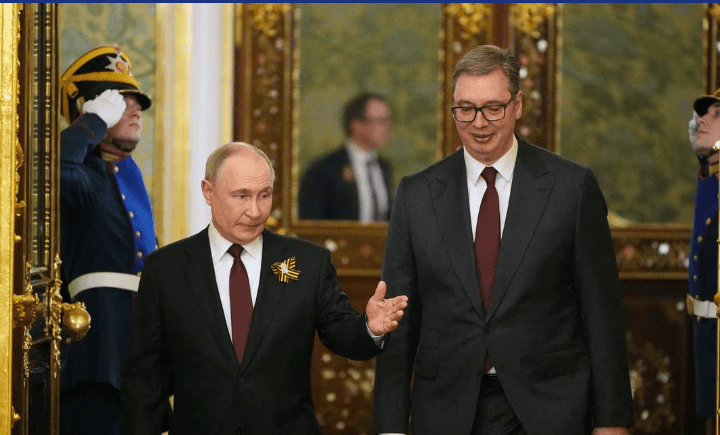 "29 out of 72 Russian diplomats are connected to intelligence - political scientist reveals Moscow's network of influence in Serbia"
 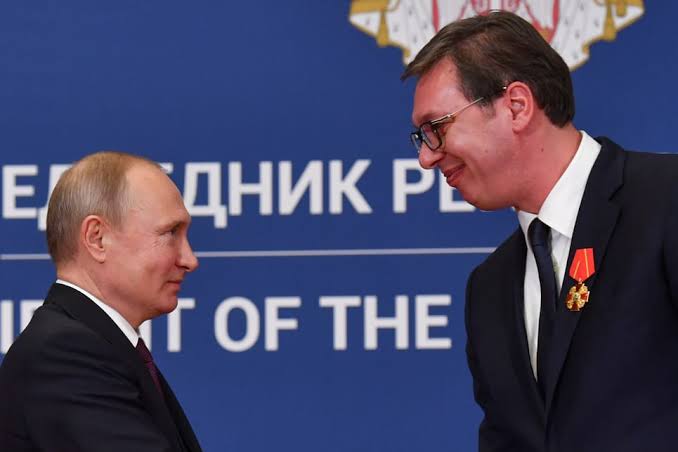 EU seeks distancing from Moscow, Vucic promises Putin more cooperation
 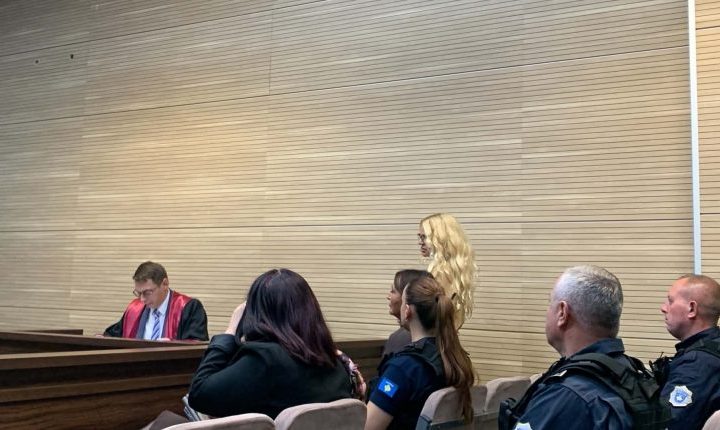 Appeal upholds 6-year prison sentence against Jelena Djukanovic for spying for Serbian BIA
  Kosovo Assembly approves in principle the Draft Law on Amending the Law on the Specialist Chambers in The Hague
  Wilson: Vučić's regime is trying to prevent the Serbian diaspora from voting, just like Georgian Dream in Georgia
  Biljana Plavšić, the woman who kissed Arkan after the massacre and called Bosniaks "corrupted genetic material"