
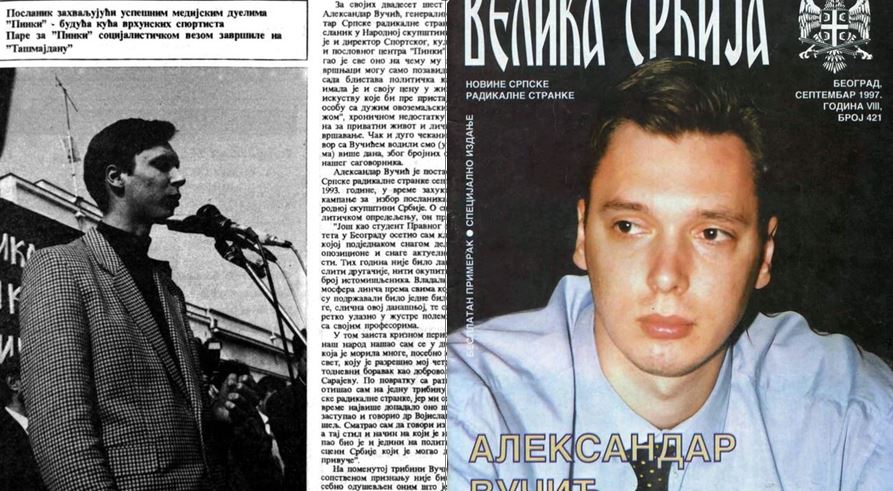
As a young man, Serbia's current president, Aleksandar Vučić, implemented a criminal policy in Sarajevo – with consequences that continue to this day.
This is how the article published by begins: German media FAZ, which brings to mind the past of Serbian President Aleksandar Vučić, focusing on his participation as a volunteer during the war in Bosnia and Herzegovina and the statements he himself made in the 1990s.
The article begins with the history of the Sarajevo Jewish Cemetery, one of the city's symbolic sites, where during the 1.425-day siege of Sarajevo, the Serbian army had set up sniper and artillery positions.
During this period, more than 11 civilians were killed, while the cemetery became one of the strategic points from which the city's neighborhoods were bombed.
According to FAZ, Vučić himself admitted in interviews in 1994 and 1997 that he had served as a volunteer in Bosnia during the war.
In an interview for the Serbian magazine Duga, published in August 1994, he stated:
“When the war broke out in Bosnia, I went to Sarajevo and volunteered to defend Serbian identity.”
In the same interview, Vučić claimed that he had spent “some time in the Jewish Cemetery” in Sarajevo, before going to Pale, the political and military center of the Bosnian Serb leadership during the war.
Vučić served as a volunteer in the Serbian forces and publicly supported the policy of Greater Serbia, as documented in interviews and publications of the time.
In a special edition of the magazine Velika Srbija (“Greater Serbia”), the organ of the Serbian Radical Party, published in 1997, Vučić wrote that he had spent a total of eight months in Serb-controlled areas of Bosnia, two of which were on the front line.
The article also recalls that at the time Vučić was a rising figure in Vojislav Šešelj's Serbian Radical Party, later convicted of war crimes by the Hague Tribunal.
Also mentioned are Bosnian Serb leaders Radovan Karadzic and Ratko Mladic, who have been sentenced to life imprisonment for genocide and crimes against humanity by the International Criminal Tribunal for the former Yugoslavia.
According to FAZ's analysis, Vučić's statements from the 90s show his open support for the "Greater Serbia" project, including territorial claims to Bosnia and Croatia.
The article concludes by assessing that, although today the Serbian president publicly declares that he respects the Dayton Agreement and the territorial integrity of Bosnia and Herzegovina, nationalist rhetoric continues to be present in the political and media discourse near the government in Serbia.
The author raises the question of whether changes in international geopolitical balances could encourage the return of old nationalist ambitions in the region, recalling Vučić's statements from 1997 that Serbia should wait for the right moment to "reclaim its lands."
 Who are the two Serbs arrested on suspicion of war crimes in Kosovo?
  US Congress passes resolution against holding OSCE Assembly in Belgrade, mentions Serbia's position on Kosovo
  Kamberi: Vučić's regime must leave, Serbia must confront the crimes in Kosovo
  From November, Russians, Chinese and Turks will need visas to enter Montenegro
  Videnovic: Vucic's "Serbian World" is a shattered illusion, Serbia must move away from Russian influence
  Marton: Vučić is bringing back the symbols of the Milošević era and the rhetoric of the '90s (Video)