
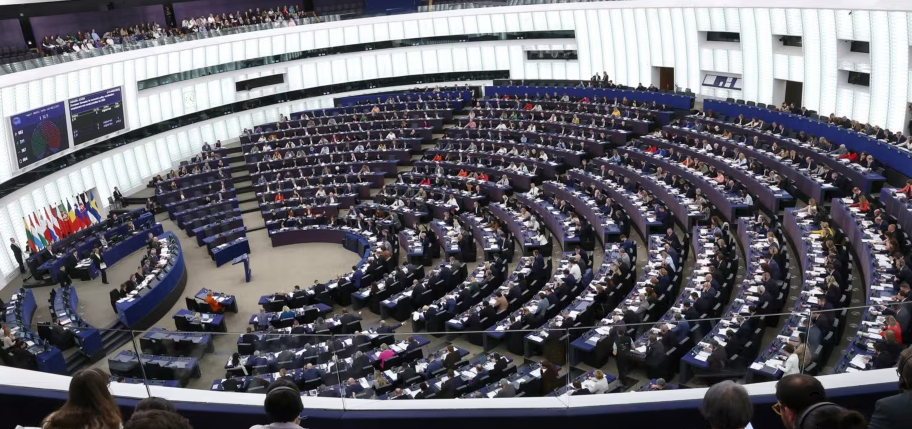
Croatian MEPs in the European Parliament, during a debate on Vukovar, called on Serbia to open its war archives, provide data on missing persons and stop glorifying war criminals.
A debate on the fall of Vukovar was held on Monday evening in the plenary session of the European Parliament in Strasbourg, marking the 35th anniversary of the city's destruction. The debate preceded a vote on a resolution on Vukovar, scheduled for Thursday, November 26.
This is the first resolution on the suffering in Vukovar prepared by a European or international institution. It was jointly proposed by Croatian MEPs from four political groups in the European Parliament.
MEP Tonino Picula said the resolution confirms what international courts have already determined: Vukovar was a victim of aggression.
“The crimes in Ovčara, Velepromet and in the camps in Serbia are not a matter of interpretation. These are proven facts,” Picula said. He added that the resolution’s purpose “is not to stir up old divisions, but to try to close the wounds that are still open today.”
He recalled that more than 1,700 families still do not know the fate of their loved ones.
"We expect Serbia to finally open its war archives and provide data on the missing," Picula said.
According to him, the public tributes at Ratko Mladić's funeral in Belgrade show "how unfinished this process is."
Karlo Ressler, also an MEP from Croatia, recalled the 87 days of siege and, as he put it, “the heroic resistance of the defenders who defended their homes street by street, among them many members of the Serbian people in Croatia.”
“The Hospital, the Water Tower, the Wine Street and the Vathi have a special place in Croatian national memory, but they also carry important civilizational lessons for all of Europe,” Resler said.
He added that there is no true reconciliation without truth, but there is no lasting peace without the ability to forgive.
Croatian MEP Gordan Bosanac said the resolution "unfortunately comes 35 years too late" and questioned whether it could have stood more firmly with those who opposed the war at the time.
Austrian MP Helmut Brandstätter assessed in the debate that war in the EU had become impossible and that "eternal enemies like Germany and France" had become allies.
According to him, the same thing should be achieved in the Balkans.
"The crimes of the past cannot be denied. In the battle for Vukovar, exactly 35 years ago, the Yugoslav People's Army and the Serbs committed incredible and serious war crimes," Brandstatter said. "But now we must look forward," he stressed.
What does the draft resolution say?
The draft describes the defense of Vukovar as a central place of Croatian national memory and a symbol of resistance to “Milošević’s Greater Serb aggression.” It says Vukovar was the first European city after World War II to be almost completely destroyed.
Referring to the work of the Hague Tribunal, the draft regrets that not all perpetrators of the crimes have been brought to justice. The memory of Vukovar is presented as a European issue, not just a Croatian one.
Serbia is being asked to provide access to war archives and publish data on individual and mass graves. It is also being asked to fight impunity for war crimes, help find and identify the missing, and return the remains to their families.
Belgrade is being urged to finally adopt the long-promised law on missing persons "in a truly comprehensive and transparent manner."
The draft condemns all forms of denial, minimization and glorification of war crimes, including public tributes to convicted war criminals. It particularly condemns the tributes to Ratko Mladić at the funeral in Belgrade on 7 September 2026. According to the draft, such practices undermine reconciliation and do not respect the court's decisions.
Student List Reaction
The student movement in Serbia announced that it disagrees with the content of the draft resolution. According to it, the document does not contribute to an objective view of historical events and reconciliation between the peoples of the former Yugoslavia.
In a statement on the X network, it is said that the proposed resolution almost completely ignores the suffering of the Serbian civilian population in Croatia, including killings, persecution, destruction of property and mass displacement.
It is emphasized that events such as Operations "Flash" and "Storm", as well as crimes against Serbian civilians, cannot be left out of a summary of this period.
The students believe that “responsibility for war crimes should be individual and determined based on evidence and final court decisions, and not attributed to entire nations.”
They say that true reconciliation is only possible through an honest confrontation with all crimes, regardless of who committed them and against whom they were committed. They assess that the draft resolution in its current form does not contribute to a balanced culture of memory and does not comprehensively and objectively include the suffering of all peoples during the wars of the 1990s.
One of the proposers of the resolution, Karlo Resler, responded that the European Parliament will pay homage to the victims of Vukovar and Ovčara on the occasion of the 35th anniversary of the destruction and terrible crimes.
"The next government will decide for itself: either it will truly reject Milosevic's legacy and move towards Europe, or it will enter the same labyrinth, the same mess of mythomania and poisonous propaganda that has kept Serbia in shackles for decades," Resler declared on the X network.
Why a resolution on Vukovar now?
Because of the thirty-fifth anniversary of the fall of Vukovar, which was marked on November 18 of this year.
On that day in 1991, after 87 days of fierce fighting and the destruction of the city, the defense of the Croatian forces was broken.
The then Yugoslav People's Army (JNA) and paramilitary units took control of Vukovar. After entering the almost completely destroyed city, the population was persecuted, prisoners were taken to camps, and serious war crimes were committed.
Among them is the Ovčara massacre, where around 260 people were killed, mostly wounded, sick and civilians taken from the Vukovar hospital.
 BIA under Vučić's shadow: Warns of the risk of a return to autocracy in Serbia
 Networks within the BIA and the MUP are conducting a campaign against the former inspector of "Jovanjica"
 Dodik's turn their backs on Vučić after losing the elections, now they are joining the Student List in Serbia
 Bakic in the Serbian Parliament accuses the former government of links to organized crime, mentions Radoicic, Veselinovic and Belivuk
 Student List continues Vučić's narrative on Kosovo, opposes draft law on cultural heritage
 Albania brings back reservists