
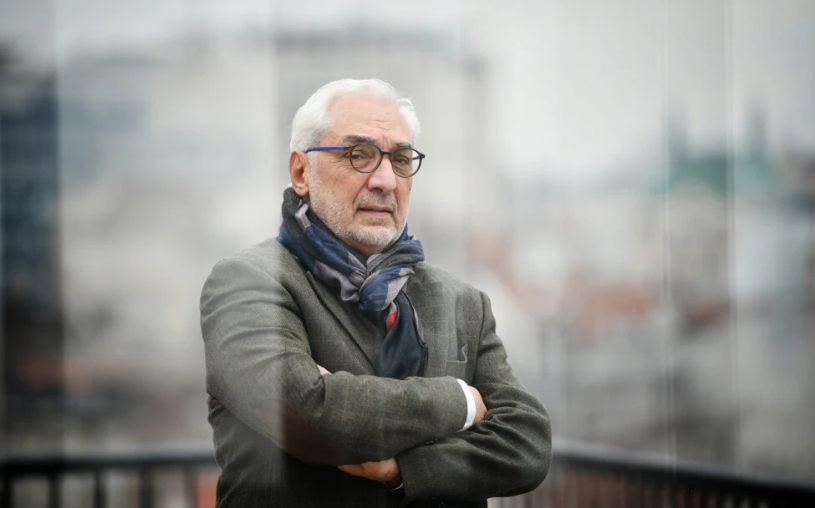
Serbian lawyer and former Deputy Minister of Internal Affairs in the transitional government after October 5, 2000, Božo Prelović, has warned that the opening of the files of the security services in Serbia could cause major political upheavals, raising a number of questions about the functioning of the BIA, its ties to power, and the surveillance of political opponents.
In an interview with Radar magazine, Prelevic said that one of the questions that needs to be answered is whether Oliver Ivanovic was under surveillance measures at the time he was killed and, if so, who ordered his placement under these measures.
He also mentioned the possibility of publishing the names of people who benefited from money from Telecom Serbia, under the leadership of Vladimir Lucic, and raised the question of whether the BIA or other security services were involved in the purchase of the Pegasus wiretapping program.
"Imagine what a shock it would be if the files were opened. Or if it were learned who took the money from Lucic's Telecom. Or if Marko Parezanovic answered the question of whether Oliver Ivanovic was under measures when he was killed and, if so, who had placed him under these measures," Prelevic declared.
According to him, after a possible change of power in Serbia, one of the main issues will not only be who won the political race, but also who lost power and for what reason.
Prelević has warned that some of the structures that have been linked to power may try to adapt to the new political circumstances, presenting themselves as former opponents of the regime or as supporters of change.
He recalled the experience of 2000, saying that after the fall of Slobodan Milosevic, many people who had lost political influence managed to return to new power structures.
"One of the problems of October 5 was precisely the fact that we did not know the list of losers, many of whom emerged again as winners," he said, warning that a repeat of this scenario would undo the meaning of the protests and efforts for change.
Prelević: Security services have 25 years without proper oversight
Speaking about the reasons why the reform of the security services was not implemented after the fall of Milosevic, Prelevic said that the problem of wiretapping and the lack of institutional control dates back to 2001.
He recalled that at that time a law was proposed that provided for more efficient internal and external control over the work of the security services, but according to him, this law had not found support from either the Democratic Party (DS), the Democratic Party of Serbia (DSS), or later from the Socialist Party of Serbia (SPS) and the Serbian Progressive Party (SNS).
According to Prelević, the lack of political will to establish proper control mechanisms has led to the services operating for decades without the necessary parliamentary, judicial, and internal oversight.
He assessed that the security services in Serbia, instead of dealing with the protection of citizens and the state, have focused on identifying so-called "internal enemies", including students, professors, journalists, politicians, activists and prosecutors.
"We have a security service that, instead of protecting citizens and the state, pursues the internal enemy among students, professors, journalists, politicians and activists, and even prosecutors," Prelević said.
He emphasized that this situation is a consequence of the lack of adequate control over services for 25 years.
In this context, he also mentioned the former presidents of the Supreme Court, Leposava Karamarković and Vida Petrović-Shkero, who, according to him, had experienced attacks because they did not allow unauthorized wiretapping.
Prelević said that the problem cannot be attributed only to Aleksandar Vučić, but also to thousands of people who, according to him, have violated professional rules and enabled the functioning of this system.
Mention the cases of Radoicic and Veselinovic
One of Prelević's most direct statements relates to Milan Radoičić and Zvonko Veselinović, two well-known names on the political and security scene in northern Kosovo.
He claimed that during his time at the Serbian Ministry of Internal Affairs, criminal proceedings were initiated against both of them, as, according to him, 2.2 kilograms of drugs were found on one, while 2.4 kilograms were found on the other.
Prelević said that the prosecutor had discontinued the proceedings, although, according to him, both had admitted to the crime, and that this had happened after Vučić came to power.
"During my time at the Ministry of Internal Affairs, criminal proceedings were initiated against Milan Radoičić and Zvonko Veselinović, because 2.2 kilograms of drugs were found on one, and 2.4 kilograms on the other. The prosecutor discontinued the proceedings, even though they had admitted to the crime, and this happened after Vučić came to power," he stated.
Prelević has requested that the prosecutor involved in these cases be asked who convinced him to drop the criminal prosecution.
These are claims made by Prelević in the interview for "Radar", while no documents or responses were provided by the persons mentioned in relation to these statements in the interview.
BIA reform does not just mean changing the name
Speaking about the possibility of reforming the security services, Prelević said that the solution does not lie solely in the dissolution of existing institutions and the creation of new structures.
According to him, changing the name of the BIA to another agency would not matter if the same people and practices remained in the new structures.
He mentioned that after October 5, 2000, the then State Security Service (DB) was renamed the BIA and new cadres were placed at its head, but over the years, according to him, the system returned to previous practices.
Prelević assessed that a genuine reform must clearly define what services the state needs and what actions should not be tolerated.
He has proposed dividing the services into three structures: intelligence service, counterintelligence and technical service. The latter, according to him, could serve the army, BIA and the Organized Crime Prosecutor's Office, but only on the basis of clear requirements and procedures.
He has also warned that after the change of power, individuals within the services may appear who will attempt to establish ties with the new authorities, discrediting those who aim for reform and supporting those who wish to maintain the status quo.
In this context, Prelević recalled the assassination of former State Security Colonel Momir Gavrilović in 2001, after a meeting with Vojislav Kostunica. According to him, Gavrilović had wanted to publish information about his associates and was killed in an ambush.
Warns that old networks can survive even after the change of power
Prelević assessed that a group consisting of financial, security, political and media structures continues to exist in Serbia, which, according to him, has only lost its political wing, but continues to have money, influence over media narratives and people within the services.
He said that these structures also possess documentation, photographs and recordings obtained through their personnel in the institutions.
According to him, this is one of the main risks for any future government that will aim to reform institutions.
Focusing on the experience of 2000, Prelević said that the split between Zoran Djindjic and Vojislav Kostunica, as well as the lack of lustration and criminal prosecution of persons who had violated the law, had created opportunities for the old structures to survive.
He recalled that the POSKOK unit, which he had formed during his tenure at the Ministry of Internal Affairs, had launched around 100 investigations within two months, but was disbanded after the first decision of the Djindjic government.
According to him, Borka Vučić and Borislav Milačić were arrested at that time, an arrest warrant was issued for Zarko Zečević, while Borisa Vuković had fled to Iraq.
Prelević said that the lack of lustration was a consequence of the political and economic interests of various actors, who did not want to face responsibility for their actions.
He has drawn parallels between that period and the current situation, warning that even a new government could face attempts at destabilization from within the institutions.
"I don't want to scare the next prime minister, but he should know that his predecessor, democratically elected, was killed because he was not sufficiently prepared to reform the services," Prelevic said, referring to the assassination of Zoran Djindjic.
He added that the next prime minister and minister of internal affairs will have serious problems if they cannot rely on people within the security services.
Criticizes the impact of services on the prosecution and police
Prelević also dedicated an important part of the interview to the functioning of the prosecution and its relationship with the security services.
He described the situation in the prosecution as one of the biggest problems in Serbia, saying that many prosecutors require that orders to take action be given in writing, in order to protect themselves from liability.
Prelević mentioned the case of Senior Public Prosecutor Nenad Stefanović, who, according to him, had requested the initiation of proceedings against Aleksandar Radić and Prelević himself, after they had first spoken about the use of a sound cannon.
He said that the prosecutor to whom the request was addressed had refused to act without a written order, while the procedure was then initiated by Stefanović's deputy.
According to Prelević, the connection between the security services and the justice system is essential, as through it, structures that have been linked to power can continue to exert influence in the future.
He has also criticized the idea of creating a prosecutor's police force, questioning who would control such a structure if it depended on a prosecutor whom he accuses of party influence.
Mention Vučić, Kokeža and Hrkalović
Prelević also spoke about the role of the National Security Council and the Bureau for the Coordination of Security Services, which, according to him, were under the leadership of Aleksandar Vučić and Nebojša Stefanović.
He assessed that the concentration of this influence in the hands of political leaders was crucial for the subordination of services to the interests of power.
In the interview, he also mentioned the former director of the Football Federation of Serbia, Slaviša Kokeza, as well as the former Minister of Interior, Nebojša Stefanović.
Prelević claimed that both had important connections with Vučić and that, despite the accusations he linked to them, they had not faced criminal proceedings.
He has also raised questions about the case of former State Secretary at the Ministry of Interior, Dijana Hrkalović, questioning the change in her statements after changing her lawyer and her release.
These statements are part of Prelević's assessments and claims in the interview.
Pegasus and questions about Oliver Ivanovic's supervision
At the end of the interview, Prelević returned to the issue of the security services files, saying that their publication could reveal information with major political consequences.
He has demanded clarification on whether the BIA was involved in the purchase of the "Pegasus" spy program, which, according to him, is sold only to states and can be used without the involvement of judges and prosecutors.
Prelević has raised the possibility that the Military Intelligence Agency (VOA) or the Military Security Agency (VBA) were also involved in this process.
He did not present the involvement of any of these structures as a fact, but demanded that this issue be investigated and answers be received.
Another question he considered important is related to Oliver Ivanovic, the political leader of Kosovo Serbs, who was killed in January 2018 in north Mitrovica.
Prelević mentioned the name of Marko Parezanović, demanding clarification on whether Ivanović was under surveillance at the time of the murder and, if so, who had ordered such a thing.
He also raised the question of who had benefited from money from Telecom Serbia and when these payments were made, linking these issues to the need to open files and clarify relations between institutions and government structures.
Prelević concluded that changing the names of institutions or appointing new leaders is not enough to change the balance of power in Serbia.
According to him, without deep reform of the security services, without accountability for past violations, and without independent institutional control, the structures that have exerted influence over the years may continue to survive even after a political change.
 Student List continues Vučić's narrative on Kosovo, opposes draft law on cultural heritage
 Albania brings back reservists
 Joseph's warning: Vučić's apparatus could undermine Serbia's stability
 Kandic nominates Kamber for the post of Deputy Speaker of the Serbian Parliament
 Student List aims to review agreements with Kosovo, EU says Serbia must implement them
 Natasha Kandic questions the credibility of the National Convention for the EU after the scandal of the nationalist melody against Kosovo