
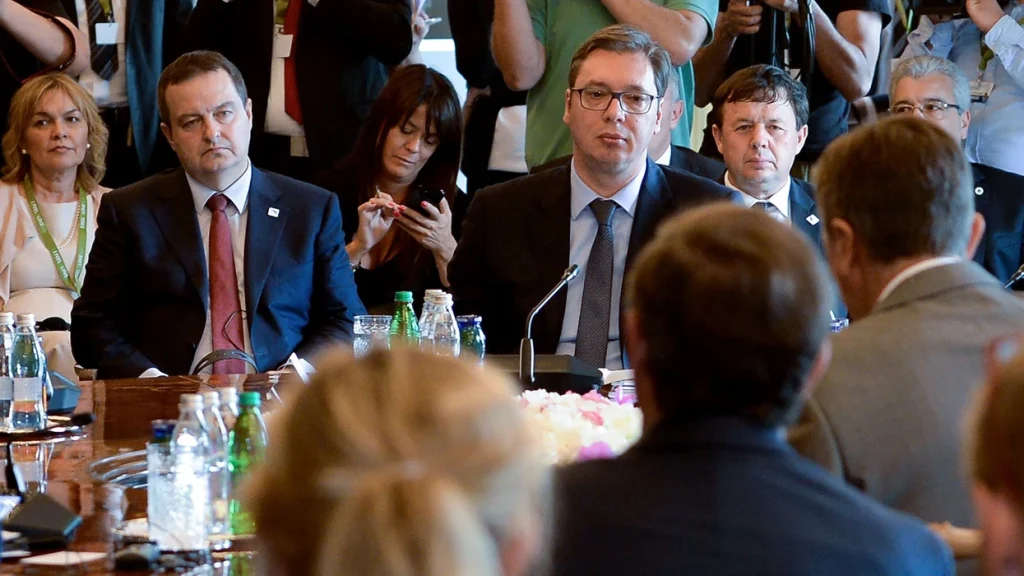
Territorial claims to Kosovo, glorification of Slobodan Milosevic's political legacy, and portrayal of opponents as a threat to national interests are taking hold in the election campaign in Serbia.
Ivica Dacic and Aleksandar Vucic, although with different messages, have placed Kosovo at the center of their political discourse, on the eve of the parliamentary elections on October 25.
In Serbia, the campaign for the early parliamentary elections on October 25 is accompanied by the return of the Kosovo issue to the rhetoric of ruling politicians. The statements of the Minister of Interior and leader of the Socialist Party of Serbia (SPS), Ivica Dacic, about the return of the Serbian flag in Prizren, as well as the accusations of Aleksandar Vucic against political opponents for their positions on Kosovo, prove that the issue of its status continues to be an important instrument of political communication in Serbia.
This rhetoric comes at a time when Vučić's government is facing increased political pressure from anti-government protests and the student movement, which has become a new factor in the election race. The protests, sparked by the tragedy at the Novi Sad railway station in 2024, have evolved into a broader challenge to the ruling Serbian Progressive Party (SNS).
National issues and relations with Kosovo, Russia, and the West are interwoven with party efforts to determine who can represent Serbia's state and national interests.
At election rallies, Ivica Dacic has made the claim that the Serbian flag will once again fly in Prizren the center of his speeches. At a rally in Belgrade, he not only repeated the statement, but also publicly challenged former German minister Michael Roth, who had criticized him for territorial claims against Kosovo.
"How dare Dacic say something like that? Well, I dare!" he is quoted as saying, linking his stance to the claim that Serbia has defended Kosovo with war and that there can be no Serbia without Kosovo.
Dacic also based his argument on his origins in Prizren, citing the declining number of Serbs living in the city and its historical importance for Serbian identity. At the same time, he presented Kosovo not as a finished political issue, but as an ongoing battle for territory and national identity.
The statements are not simply a repetition of Serbia's official stance on non-recognition of Kosovo's independence. In speaking about the return of the Serbian flag in Prizren, Dacic uses language that goes beyond diplomatic opposition to independence and returns to the electoral discourse the symbolism of territorial claim.
Michael Roth's reaction also placed this statement in the context of Serbia's relations with the European Union. Roth warned that territorial claims against a neighboring state distance Serbia from the European perspective and that this path does not lead to the EU.
For Dacic, however, the clash with a critical voice from Germany became an opportunity to present himself as a politician who does not back down in the face of external pressure. This is in line with the main message of his electoral list, “Ivica Dacic – Factor of Stability,” which aims to combine the promise of stability with the protection of national interests and the traditional SPS stance on Kosovo.
At the central rally in Belgrade, Dacic linked his party's history to Slobodan Milosevic, the founder of the SPS, and to the experiences of wars, sanctions and bombings in previous years. He presented the party as a force that has survived in the face of external pressures and internal opposition.
Thus, Dacic's campaign combines three elements: Kosovo as a national symbol, Milosevic's political legacy, and the presentation of the SPS as a stable force in the face of its opponents.
Vučić: Political opponents and Kosovo as a matter of national loyalty
A similar approach, albeit with a different form of communication, is being used by Aleksandar Vučić, who, after resigning from the post of president on September 27, is leading the electoral list "Aleksandar Vučić - United Serbia", with the aim of returning to the head of the government as prime minister.
In a campaign statement, Vučić claimed that the student list representatives would impose sanctions on Russia and recognize Kosovo's independence if they came to power. He also accused several politicians from Kosovo, Croatia, and Montenegro of supporting his political opponents in Serbia. These claims were presented by him as arguments to question the positions and national loyalty of his rivals.
So, Kosovo is presented not only as a foreign policy issue, but also as a criterion for judging who is worthy of governing Serbia.
In this way, opposing Kosovo's independence and maintaining relations with Russia are presented as part of a broader package of national interests, while political opponents are faced with the suspicion that they might abandon these positions.
Such a strategy shifts the debate from domestic issues, such as institutional accountability, corruption, and protesters’ demands, to a clash over national identity and state security. This is not to say that these topics are unimportant to the Serbian electorate, but that their use in the campaign can influence how other political issues are interpreted.
Vučić, who has dominated Serbian politics for more than a decade, is running in a polarized climate, where a student movement and anti-government protests have expanded the challenge to his rule. The Associated Press has reported that the student movement has emerged as a political force aiming to end the SNS's decades-long dominance.
In this circumstance, presenting rivals as representatives of foreign interests or as politicians who could change their stance on Kosovo shifts attention from concrete programs towards a division between those who claim to protect the state and those who are accused of potentially endangering it.
Russia, China and the legacy of Milosevic
Another element that unites Dacic's statements with the broader discourse of Serbian politics is the connection between Kosovo and foreign policy orientation.
Dacic has described Russia and China as Serbia's best friends, emphasizing their support against Kosovo's membership in international organizations. He has stated that he has contributed to efforts to convince states to withdraw recognition of Kosovo's independence and that, if his party continues to be a political factor, this policy will continue.
These statements present the policy towards Kosovo as a diplomatic battle that is not limited to the dialogue with Pristina, but also includes relations with great powers and the clash over international recognition.
Praising Milosevic in the same context also has political significance. The SPS was founded by the former Serbian leader, and, three decades after the wars of the 1990s, Dacic continues to use his legacy as part of the party's identity.
This reference should not be read solely as historical nostalgia. In an election campaign, returning to past figures and events can serve to reinforce a narrative of national continuity, to mobilize an electorate that identifies with it, and to present current politics as a continuation of a historical mission.
In Dacic's case, this narrative is built through the association of Kosovo with sacrifice, Serbian identity, and opposition to Western pressure. In Vucic's case, it appears more in the presentation of opponents as a threat to state interests and in warnings that a change of power could bring radical changes in policy towards Kosovo and Russia.
Is nationalism being used to mobilize the electorate?
Dacic and Vucic's statements, taken together, show that the Kosovo issue continues to have an important function in Serbian electoral communication. However, their motives cannot be determined solely from public statements. What can be analyzed is the way in which these statements construct messages for the electorate and what role they give to national issues in the campaign.
In Dacic's case, the statement about the Serbian flag in Prizren shifts the debate from diplomatic opposition to Kosovo's independence to territorial symbolism. In Vucic's case, the warnings of recognition of Kosovo by his opponents place the issue at the center of the debate on Serbia's political credibility and strategic orientation.
Both approaches have one thing in common: they make Kosovo a topic that can mobilize national emotions and help define dividing lines between parties. This is especially important in a campaign where the government is facing a protest movement that has expanded demands for accountability and political change.
But nationalism is not the only element of the campaign. Dacic's list also uses the slogan "Stability Factor" and promises social policies, while Vucic has presented his candidacy within the framework of a broader governing program. For this reason, the impact of the rhetoric on Kosovo should be assessed alongside the economic, social and institutional topics addressed to voters.
The October 25 elections will show what weight these messages will have in relation to the electorate's other concerns.
So, the Kosovo issue is not only part of Serbia's foreign policy. It is also part of the internal struggle for power, where history, national identity, and relations with great powers are used to construct electoral messages and determine who claims to speak on behalf of Serbia's interests.
 Serbia launches investigations against former government officials, but will the files of Banjska and Radoicic also be opened?
 Radar publishes exclusive documents on secret surveillance of Vucic's critics by the BIA
 Vučić pardoned 49 people before leaving the presidency, the list includes former officials and people involved in incidents
 Vučić's defeat in Serbia, is Belgrade's influence over the Serbian List in Kosovo coming to an end?
 A Serbia without Vučić, but with the same policy towards Kosovo?
 Serbian experts: Students take power, but not a Serbia detached from Russia and China